
Written By: Jonathan
Fact Checked By: Caroline Dezendorf
Reviewed By: Matt Tanner
So, just imagine that you are riding your bike slowly into a tight turn: till then everything feels normal but suddenly your foot taps the front wheel, breaks your rhythm and shaking your confidence.
And, it is small but unexpected contact which is known as “TOE OVERLAP” and also you need to understand that this is not a flaw of a mistake: as it is the result of how many modern bicycles are designed.
Plus, the bikes with the shorter wheelbases, steeper angles and compact frames are actually built for quicker handling and better performance, but that same design can literally reduce the space between your foot and the front tire.
Not only this, there’s studies and real-world rider reports that shows that toe overlap is most noticeable at the low speeds, specially during the sharp turns, U-turns or stop and go city riding as well.
Shockingly, many even experienced cyclists ride with it every day without any issues: not because it just disappears, but because they understand it and adapt likewise.
And, now in this guide you’ll learn How to Adjust Toe Overlap so that you can understand about the signs and how to fix or manage it using simple, practical changes.
Now, Let’s Understand About the Toe Overlap
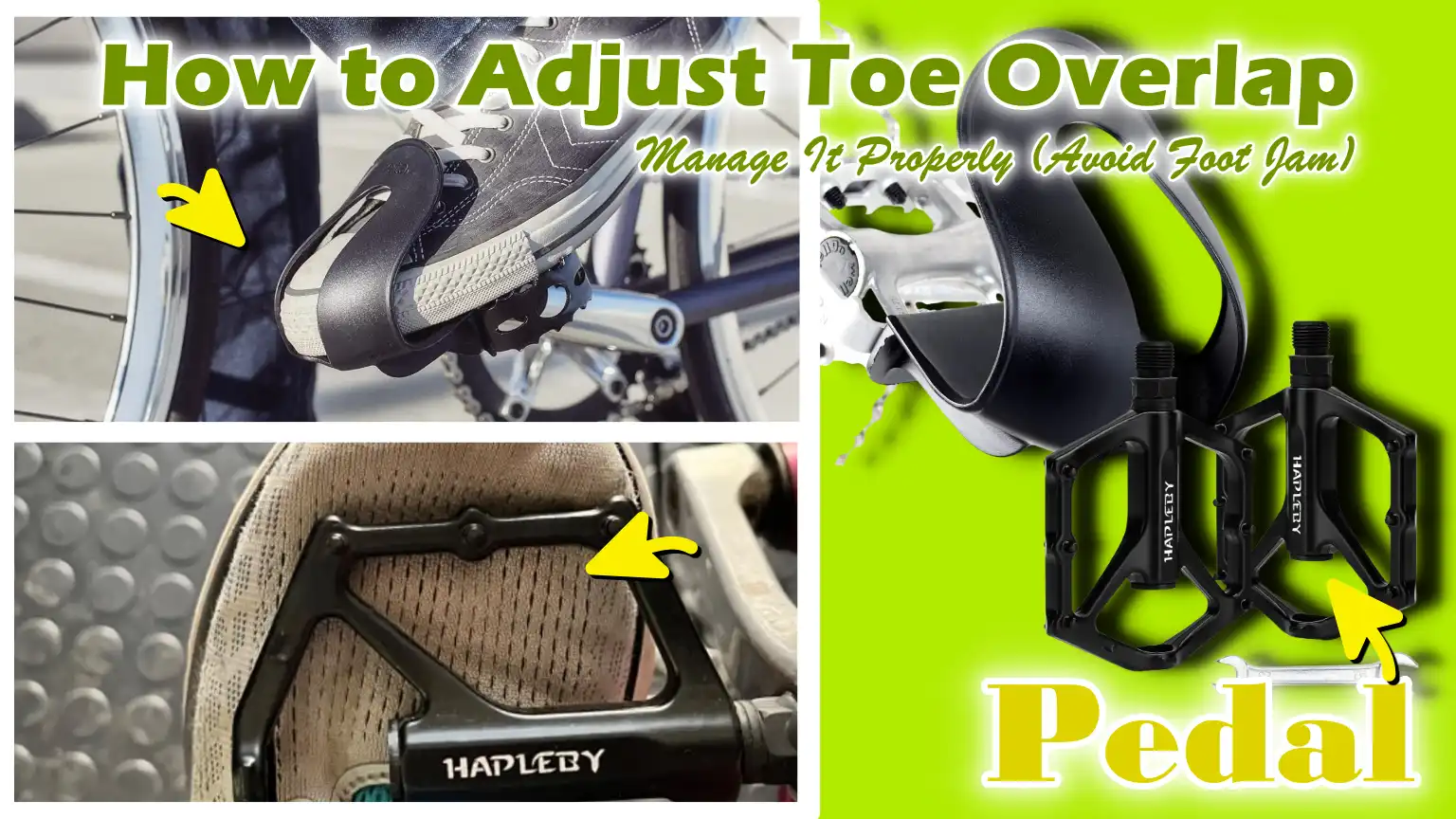
Toe overlap occurs when you turn the handlebars and the front part of your shoe touches, or comes very close to, the front wheel or tire.
This typically happens at low speeds, such as when making sharp turns, executing U-turns, or riding slowly in traffic.
It is crucial to understand that toe overlap is not an indication of a defect or damage to the bike.
It is simply a consequence of the bike’s design, particularly in models engineered for agile handling and enhanced performance.
Many road bikes and bikes with smaller frames are designed with compact geometry, which brings the front wheel closer to the rider’s feet.
Consequently, toe overlap is quite common and is often considered a normal occurrence.
The key factor is the extent of the overlap and whether it impacts your control or confidence while riding.
Once you understand why it happens, managing it and adapting to it becomes much easier.
1. Causes of Toe Overlap
Toe overlap is primarily caused by the spatial relationship between the position of your feet and the front wheel.
One of the most significant causes is a short wheelbase, meaning the distance between the front and rear wheels is relatively short.
Bikes with a short wheelbase are designed to turn more quickly and feel more responsive; however, this design also reduces the clearance between your feet and the front tire.
Another significant factor is shoe size.
Riders with larger feet naturally position their feet further forward on the pedals, thereby increasing the likelihood of contact with the wheel while turning.
Fenders and tire clearance also play a role; installing wider tires or fenders occupies more space around the front wheel, making it easier for your toes to make contact with them.
A small frame size is another common contributing factor.
On smaller bikes, the front wheel is positioned closer to the rider to maintain proper balance and handling, thereby increasing the likelihood of toe overlap.
All of these factors represent standard design choices; however, when they converge, the issue of toe overlap can become significantly more pronounced.
2. Types of Toe Overlap
Toe overlap is classified based on the frequency and severity with which it impacts your ride and it is generally categorized into two main levels.
Mild overlap occurs when your toe makes only occasional contact with the tire, typically while executing very sharp turns at low speeds.
In such instances, it does not interfere with normal riding and can often be easily managed with a little awareness and minor adjustments to riding technique.
Many experienced riders also experience a degree of ‘toe overlap’ but do not consider it to be a problem.
Severe overlap occurs when your toe repeatedly strikes the tire, or even gets jammed in the wheel, while turning.
This experience can be unsettling and may compromise your control, particularly if it happens unexpectedly.
Severe overlap is typically an indication that adjustments are needed to harmonize the relationship between the bike’s size, its setup and your riding position.
It is crucial to determine whether your toe overlap is mild or severe, as this helps you decide whether you simply need to make minor refinements to your riding style, or if specific adjustments to the bike’s setup are required to ensure greater safety and comfort.
Is Toe Overlap Dangerous?
Toe overlap is not inherently dangerous in itself, but it can become a problem, depending on when and how it occurs.
Simply put, it poses a risk only when you are actively attempting to control the bike and your foot obstructs the path of the front wheel.
On most modern bicycles, particularly road bikes and those with smaller frames, toe overlap is, to some extent, a deliberate design feature and countless riders navigate these bikes safely every day.
The key factors here are timing and awareness.
If the bike is moving slowly and you are executing a sharp turn, and at that precise moment, your foot strikes the wheel, it can disrupt your balance or steering.
However, when you are riding at normal or higher speeds, the likelihood of this occurring is very low.
Understanding the distinction between risky and safe situations allows riders to maintain their balance and avoid unnecessary anxiety.
Rather than viewing toe overlap as a constant threat, it is more accurate to regard it as a specific scenario that requires awareness and proper handling.
1. Situations Where It Matters – Sharp Turns, Low Speeds
Toe overlap matters most when you are riding at low speeds and executing sharp turns; this is because, in such moments, your front wheel is turned to its maximum angle while your foot remains in a forward position.
Common scenarios where this occurs include making U-turns, turning at intersections, riding in traffic, navigating narrow paths, or turning immediately after coming to a stop.
At low speeds, your balance relies heavily on steering and body control; Therefore, even the slightest obstruction such as: your toe striking the tire, as it can feel sudden and jarring.
If your foot collides forcefully with the wheel, it may momentarily impede the wheel’s rotation or distract you; if you are unprepared for this, you could lose your balance.
This is why new riders perceive toe overlap more acutely than experienced riders, as they are still in the process of learning how to position their feet correctly while cornering.
In such situations, awareness and a few simple habits such as: ceasing to pedal while turning, as it can significantly mitigate the risks.
2. Situations Where It Doesn’t Matter – Cycling at High Speeds
When you are cycling at high speeds, “toe overlap” rarely poses a problem; this is because, at these higher velocities, your cycling technique undergoes a complete transformation.
When moving rapidly, you do not turn the handlebars as sharply as you would at lower speeds.
Instead, you lean the bicycle in the direction of the turn; by doing so, the front wheel remains largely aligned with your direction of travel and stays clear of your feet.
Furthermore, your pedals remain in constant motion, meaning your foot does not remain stationary in the forward position long enough to come into contact with the tire.
For this very reason, toe overlap rarely impacts your performance during long-distance cycling or while navigating sharp turns.
Many professional and experienced cyclists ride bikes that exhibit toe overlap, yet they do not consider it an issue, as it creates no hindrance during normal or high-speed cycling.
This demonstrates that ‘toe overlap’ is not, in itself, a hazard; rather, it becomes a problem only under specific circumstances.
3. Cyclists’ Experiences in Real Life
In real-world cycling scenarios, most cyclists who face ‘toe overlap’ quickly learn to adapt to it.
Many cyclists report experiencing it only during their initial rides, or specifically when making sharp turns in tight spaces.
Over time, cyclists naturally make subtle adjustments to their technique such as: momentarily pausing their pedaling while executing sharp turns, or slightly altering their foot positioning.
Experienced cyclists often remark that ‘toe overlap’ becomes something they are aware of, yet no longer worry about.
However, cyclists whose bikes exhibit severe ‘toe overlap’, or those riding bikes that are ill-fitted to their body dimensions, may experience this issue more acutely and may wish to make minor adjustments to enhance their comfort and control.
Overall, practical experience suggests that ‘toe overlap’ is a common occurrence; it is easily manageable and with the right understanding, it rarely poses a safety risk.
The primary objective is not to eliminate it entirely, but rather to learn how to cycle safely and confidently even in its presence.
How to Check for Toe Overlap?
Checking for toe overlap is a crucial step, as it helps you clearly understand whether or not your bike’s setup is compromising your control.
Many riders are unsure whether they are truly experiencing an issue or if it is merely an occasional occurrence; therefore, performing a proper check eliminates this confusion.
The toe overlap check should be conducted in a controlled and systematic manner, allowing you to safely observe how your foot and the front wheel interact with one another.
There are two reliable methods for performing this check: one while the bike is stationary and the other while riding at a slow speed.
Both methods are easy to execute and provide a clear indication of how frequently, or closely, your toe comes into contact with the tire.
By conducting a thorough assessment, you can gauge the severity of the overlap and determine whether you need to make adjustments to your bike’s setup or simply refine your riding technique.
1. The Static Check
The static check is the easiest and safest way to begin, as it does not require moving the bike.
Sit on your bike in your standard riding position, ideally while wearing the same shoes you typically use for cycling, as shoe size and shape directly influence the results.
Place one foot on the pedal in the forward position, as this is the point where toe overlap is most likely to occur.
Now, slowly turn the handlebars fully to one side and observe the clearance (the space) between your toe and the front tire or fender.
If your toe strikes the tire, or comes into very close proximity to it, this confirms the presence of toe overlap.
In this way, you can identify the maximum potential overlap without incurring any risk.
This is a simple yet highly effective method for understanding how your bike’s geometry and your foot positioning interact with one another.
Even if you do not experience any discomfort while riding, this check provides you with a clear and precise assessment of the situation.
2. Dynamic Check
The dynamic check reveals how toe overlap actually affects you under real-world riding conditions.
Find a safe, open space where you can cycle slowly without any obstructions.
Begin cycling at a low speed and attempt to execute sharp turns such as: a U-turn or a tight corner.
Pay close attention to how your foot moves when the pedal is in the forward position and observe how close it comes to the front wheel.
If your toe strikes the tire or impedes your movement, note the impact this has on your balance and control.
This method is crucial because, often, toe overlap may appear quite significant during a static check, yet it poses no actual problem while cycling.
Conversely, it may feel more pronounced while in motion, particularly for beginners.
By performing this check, you can not only detect toe overlap but also determine its actual impact on your riding comfort and safety.
Tools
| Tool/Item | Why It Is Needed | How to Use It Properly |
|---|---|---|
| Allen Keys | It is essential to adjust components such as the saddle position, cleats and stem, as these directly influence toe overlap. | Select the correct tool size, insert it into the bolt and turn it gently to loosen or tighten; avoid applying excessive force. |
| Bike Stand – Optional | This allows you to work safely and clearly observe the adjustments being made without the bike tipping over or shifting. | Mount the bike on a stand, ideally one that lifts the rear wheel, and proceed to adjust the components while keeping the bike stable. |
| Proper Cycling Shoes | Foot size and positioning affect toe overlap; therefore, using your actual riding shoes yields the most accurate results. | Wear these shoes during the inspection and adjustment process to precisely determine your correct foot positioning and avoid inaccurate measurements. |
| Measuring Tape – Optional | This tool assists you in measuring the saddle position, foot placement and the minor adjustments necessary for precise fine-tuning. | Measure the clearance between your toe and the tire, or track the movement of the saddle and record these changes to ensure a consistent setup. |
How to Adjust Toe Overlap – Effective & Easy Process
Adjusting toe overlap does not imply making drastic changes; rather, it involves making small, careful adjustments to maximize the clearance between your foot and the front wheel without compromising your comfort or control.
Toe overlap depends on factors such as your foot placement on the pedals, your body posture on the bike and the specific geometry of the various components.
The objective is to ensure that your foot does not extend too far forward, or come too close to the front tire, particularly when you are cornering.
It is crucial to make only one adjustment at a time and test it thoroughly, as excessive changes can lead to new issues, such as discomfort, difficulty in pedaling, or physical strain on your body.
When executed correctly, even minor adjustments can make a significant difference in making your ride safer and more reliable.
1. Adjust Cleat Position – For Clipless Pedals
If you use clipless pedals, adjusting the cleat position is the most effective method for reducing toe overlap, as it directly determines where your foot sits on the pedal.
Shifting the cleats slightly backward moves your foot further back as well, thereby preventing your foot from extending too far toward the front wheel.
When done correctly, this minor adjustment creates more clearance for your feet without negatively impacting your balance.
You can also adjust the cleats slightly inward or outward to ensure they align correctly with your foot’s natural anatomy; this helps alter your foot angle and further minimizes the risk of striking the tire while cornering.
After making adjustments, it is crucial to test your pedal stroke by riding the bike under normal conditions to assess your comfort level, pedaling ease and knee alignment.
The correct cleat position should feel natural and efficient, while also minimizing the risk of your foot striking the tire.
2. Adjusting Foot Placement – For Flat Pedals
If you ride a bike equipped with flat pedals, you have greater freedom to adjust your foot placement, which makes managing “toe overlap” easier.
Positioning your foot slightly further back on the pedal prevents your foot from extending too far forward, thereby directly reducing the risk of it striking the front wheel.
This adjustment should be subtle and controlled to ensure you remain stable and balanced while pedaling.
You can also fine-tune the width of your stance by slightly altering the distance between your feet and the bike frame.
A slightly wider stance can sometimes provide greater clearance for your feet and improve control, particularly when cornering.
The key is to select a position that feels natural to you and provides sufficient clearance to avoid contact with the tire.
3. Adjusting Saddle Position
Saddle position plays a pivotal role in your overall riding posture and can indirectly influence “toe overlap” (the risk of your foot striking the tire).
Shifting the saddle slightly backward redistributes your body weight toward the rear, thereby moving your feet a little further away from the front wheel.
This can provide a bit of extra clearance when cornering.
However, this adjustment must be made with caution, as saddle position significantly impacts pedaling efficiency and overall riding comfort.
After adjusting the saddle, you should check your reach to the handlebars to ensure that you do not experience any excessive stretching or discomfort.
With the saddle correctly positioned, pedaling should feel effortless, leg extension should be optimal and your riding stance should feel balanced; furthermore, this should also help minimize issues related to toe overlap.
4. Adjusting the Handlebars and Stem
Adjusting the handlebars and stem can alter your body position on the bike, which may have a subtle impact on “toe overlap.”
Extending your reach by using a slightly longer stem causes your upper body to lean further forward, which can alter the positioning of your legs and feet while pedaling.
Adjusting the handlebar angle can also improve comfort and control, particularly when riding at slow speeds or navigating sharp turns.
These adjustments do not directly alter the position of the front wheel or your feet; rather, they help optimize your overall riding posture, thereby reducing instances of toe overlap.
It is crucial to implement these adjustments in small increments and evaluate them carefully to ensure that you do not experience any discomfort in your back, shoulders, or wrists.
5. Use Smaller or Thinner Tires
Tire size has a direct impact on the available space (clearance) around the front wheel.
Using slightly narrower tires reduces the overall tire width, and sometimes its outer diameter, potentially creating a little extra room for your foot.
If your current tires feature large or highly pronounced tread patterns, switching to smoother or less aggressive tires can also help minimize the likelihood of your foot striking the tire.
However, whenever making changes to your tires, you should always take into account your bike’s compatibility and your specific riding requirements.
While narrower tires can increase clearance, they may also affect your comfort and grip, depending on the type of terrain you ride on.
The goal is to strike a balance that allows you to increase clearance around the front wheel while maintaining the bike’s overall performance.
6. Remove or Adjust Fenders
Fenders can exacerbate the problem of “toe overlap” (where your foot strikes the tire) because they occupy additional space around the front wheel, particularly in the area where your foot passes through while turning.
If your foot is striking the fender rather than the tire itself, adjusting or repositioning the fender can help create more clearance.
In some cases, the obstruction can be reduced without completely removing the fender, either by trimming it slightly or by installing a fender with a lower-profile design.
If your riding conditions do not necessitate the use of fenders, removing them entirely can completely eliminate that additional risk of contact.
This is a minor adjustment, but it can make a significant difference, specially for riders who use wide tires or ride in congested urban environments where making turns at low speeds is a common occurrence.
Know, The Advanced Solutions for Toe Overlap
Advanced solutions for toe overlap are useful when minor adjustments such as: changes to cleat position, foot placement, or saddle position, are insufficient to resolve the issue.
These methods involve replacing major bike components or considering a different type of bicycle; therefore, they should be approached with caution.
Toe overlap is deeply intertwined with how far forward your foot extends and how close the front wheel is to your riding position.
By making minor modifications to components or the bike’s design, you can alter these factors and effectively mitigate, or completely eliminate, the problem.
However, these changes can also impact your pedaling efficiency, comfort and riding style; therefore, before implementing any modifications, it is crucial to understand the specific objective of each change.
These solutions are particularly beneficial for riders who experience frequent or severe toe overlap issues and who are seeking a more permanent and reliable resolution.
1. Use Shorter Crank Arms
Crank arms are the components that connect the pedals to the bicycle and their length determines the distance your foot travels during each pedal stroke.
Longer crank arms push your foot further forward as the pedals rotate, thereby increasing the likelihood of your toe striking the front wheel.
By utilizing slightly shorter crank arms, you can reduce this forward extension, naturally creating more clearance between your foot and the tire.
This can be an effective method for reducing toe overlap that does not require making major alterations to your overall riding position.
For some riders, particularly those with shorter leg lengths, shorter crank arms can also make pedaling more comfortable.
However, this may result in a slight alteration in the perceived power output generated with each pedal stroke.
It is crucial to select a crank length that is appropriate for your body measurements and riding style, while also helping to minimize toe overlap.
2. Change the Pedals
Pedals can also influence toe overlap, as they determine the distance at which your feet are positioned relative to the bike and how they align during pedaling.
Some pedals feature a longer spindle length, which positions your feet slightly further outward from the frame.
This minor adjustment in width can alter your foot angle and reduce the likelihood of your toes striking the front wheel while turning.
Although this difference may seem negligible, a shift of even a few millimeters can significantly improve clearance.
Nevertheless, caution should be exercised when changing pedals, as this also impacts your stance width and overall comfort.
Some riders may find a wider stance to be more stable; however, excessive width can lead to discomfort in the knees or hips.
The goal is to find a pedal setup that provides slightly increased clearance while still feeling natural and comfortable during long rides.
3. Frame Geometry Considerations
Frame geometry is one of the primary causes of “toe overlap,” and in some instances, this issue cannot be fully resolved without replacing the bike itself.
If you continue to experience frequent and severe toe overlap issues, even after making adjustments, and if this compromises your control over the bike, it is advisable to consider purchasing a bicycle with a different design.
On bikes with a long wheelbase, the front wheel is positioned further away from the rider, thereby reducing the likelihood of the rider’s foot striking the wheel.
Touring bikes serve as an excellent example of this, as they are specifically designed with stability and comfort in mind.
These bikes often feature ample clearance between the rider and the front wheel.
Conversely, road bikes are engineered for speed and agile handling, characteristics that typically result in a shorter wheelbase and a higher potential for “toe overlap.”
The issue of overlap becomes even more pronounced on bikes with smaller frame sizes, as the front wheel is positioned closer to the rider to maintain balance.
Understanding these distinctions enables you to make a more informed decision when selecting a bicycle.
In some instances, the most effective and sustainable solution is to choose a frame that naturally provides greater clearance while simultaneously meeting your specific riding requirements.
Learn, About the Riding Techniques to Avoid Toe Overlap
Riding techniques are one of the easiest and most effective ways to manage toe overlap, as they require no modifications whatsoever to your bike.
Toe overlap occurs most frequently at low speeds and while making sharp turns; this means that your riding style has a direct impact on whether or not this issue arises.
By adopting a few basic habits, you can avoid contact between your foot and the front wheel, thereby maintaining effortless control over your bike.
These techniques are widely utilized by experienced cyclists and are considered standard riding skills, particularly when navigating tight spaces, city traffic, or riding at low speeds.
The core principle involves controlling when and how your feet move while turning, ensuring that your foot never enters a position where it could obstruct the wheel.
1. Stop Pedaling When Making Sharp Turns
One of the most crucial techniques is to stop pedaling when making sharp turns at low speeds.
Toe overlap typically occurs when your foot is in a forward position and the handlebars are turned sharply.
By pausing your pedaling for a brief moment, you prevent your foot from entering this hazardous zone.
This allows the front wheel to rotate freely without any obstruction.
This technique is particularly useful when executing U-turns, navigating intersections, or maneuvering through narrow passages.
It also enables you to focus more on balance and steering, rather than pedaling, resulting in improved overall control.
Once the turn is complete and the handlebars are straightened out again, you can easily resume pedaling.
2. Keep Your Inside Foot Up
Keeping your inside foot in an upward position is another highly effective method for avoiding toe overlap.
When you execute a turn, the foot on the inside of the turn moves closer to the front wheel, thereby increasing the likelihood of it striking the tire.
By lifting one foot slightly and lowering the opposite pedal, you create greater clearance between your foot and the wheel.
This technique also enhances balance, as it lowers your center of gravity toward the outside of the turn, providing you with greater stability.
This is a common practice employed by experienced riders, particularly when navigating controlled, low-speed turns.
With practice, this becomes a natural motion, one that you begin to execute automatically, without conscious thought.
3. Anticipate Sharp Turns in Advance
Anticipation is a crucial skill that enables you to avert the issue of “toe overlap” before it even arises.
By looking ahead and recognizing that a sharp turn is imminent, you can prepare your body and adjust your pedaling technique in advance.
This means you can cease pedaling at precisely the right moment, position your feet correctly and steer the handlebars smoothly without any sudden or jerky movements.
Anticipating turns also reduces the likelihood of panicking or making hasty maneuvers, factors that often serve as the primary causes of unwanted contact between your foot and the wheel.
This ability to anticipate effectively not only improves your proficiency in handling situations like toe overlap but also enhances your overall safety and confidence while cycling in a variety of conditions.
Know, Common Mistakes of Toe Overlap to Avoid
When attempting to resolve the issue of toe overlap, many riders focus solely on eliminating the problem as quickly as possible.
In doing so, they often make adjustments that create significant issues regarding comfort, control, or long-term physical well-being.
Toe overlap is often a minor and easily resolvable issue; therefore, the objective should be to resolve it without compromising the bike’s overall balance or your riding position.
Mistakes typically occur when adjustments are made without a proper understanding of how the various components of the bike interact with one another.
A well-tuned bike is the result of a harmonious interplay between your body, the pedals, the saddle and the handlebars.
If you make excessive adjustments to any single component, or use parts that are incompatible with the bike, it can diminish the bike’s performance, cause discomfort, or even lead to pain during long rides.
By avoiding these common mistakes, you can resolve the toe overlap issue safely and effectively, while ensuring that your bike remains comfortable and easy to ride.
Not only this, there’s scientific research on the cycling biomechanics that confirms that even small adjustments in the bike setup can influence how a rider moves and performs, so study actually analyzes the saddle position, body angles and frame geometry that shows that these factors directly affects the pedaling efficiency and foot placement, so that’s why you need to adjust the cleats, saddle position and riding posture so that you can reduce toe overlap while still maintain the comfort and performance in-tact.[¹]
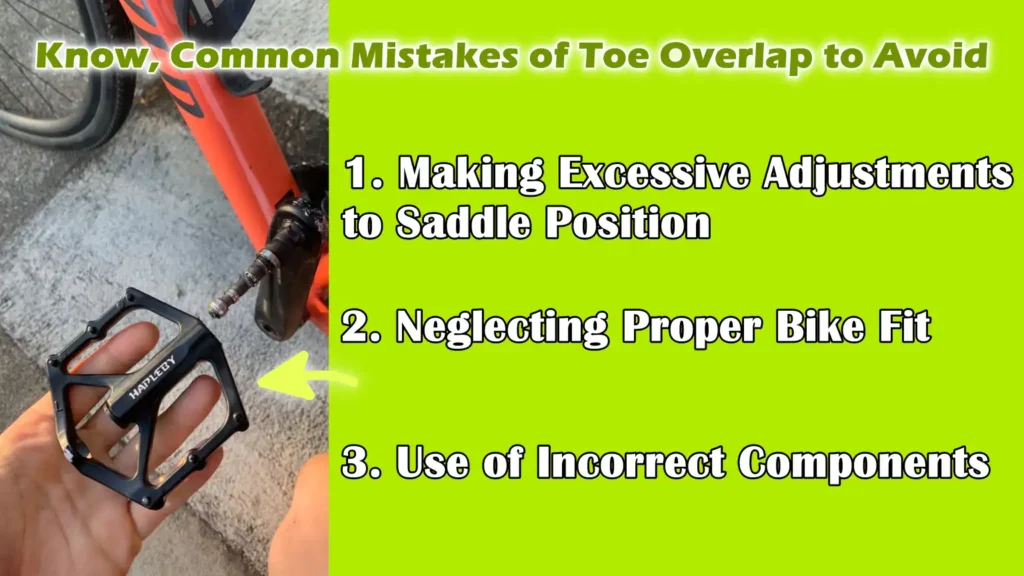
1. Making Excessive Adjustments to Saddle Position
One of the most common mistakes is sliding the saddle too far back in an attempt to create more clearance between your foot and the front wheel.
While minor adjustments may offer some relief, drastic changes can have a detrimental effect on your pedaling mechanics.
The saddle plays a pivotal role in determining your leg movement, the distribution of your body weight and the efficiency with which you transfer power to the pedals.
If the saddle is positioned too far back, you may have to strain excessively to reach the handlebars, your pedaling efficiency may diminish and unnecessary pressure could be placed on your knees and lower back.
Over time, this can lead to discomfort or even injury.
The correct approach is to make only minor adjustments at a time and after each adjustment, always verify that your pedaling feels natural and comfortable.
No one should ever compromise proper riding form solely to resolve the issue of toe overlap.
2. Neglecting Proper Bike Fit
Another major mistake is focusing exclusively on the overlap issue while overlooking the overall bike fit.
Bike fit serves as the foundation for comfort, safety and performance; it encompasses aspects such as correct saddle height, saddle position, handlebar reach and proper leg alignment.
If your bike is not properly configured to suit your body measurements, the issue of “toe overlap” may appear far more severe than it actually is.
For instance, riding a bike with a frame that is too small can exacerbate the overlap problem, as the front wheel sits closer to your feet.
Similarly, improper cleat positioning or poor riding technique can cause your feet to extend further forward than necessary.
Rather than merely treating the symptoms, it is crucial to ensure that your bike fits your body perfectly.
A properly fitted bike simultaneously mitigates a multitude of issues, including toe overlap, thereby making the riding experience more stable and comfortable.
3. Use of Incorrect Components
Using components that are ill-suited to your bike or your riding style is another mistake that can exacerbate the problem of toe overlap or create new complications.
For instance, installing overly wide tires or oversized fenders can reduce the clearance around the front wheel, thereby increasing the likelihood of toe overlap.
Similarly, using pedals with varying spindle lengths or an incorrect cleat setup can alter your foot positioning in a way that causes your feet to sit too far forward.
If incompatible components do not integrate properly with your bike’s design, they can negatively impact the bike’s handling, balance and safety.
It is crucial to select components that are specifically recommended for your bike and riding requirements and to ensure that they function together harmoniously.
By making thoughtful and appropriate component choices, you can help mitigate the issue of toe overlap while maintaining your bike’s performance and comfort.
Read More:
How to Install Toe Clips on Bike Pedals
How to Fix a Sticky Dropper Post
How to Adjust Dropper Post Cable
When You Should Not Make Changes?
It is important to understand that toe overlap does not always require fixing.
In many cases, attempting to eliminate it completely can exacerbate problems rather than resolve them.
Toe overlap is often a natural consequence of a bike’s design, particularly in performance-oriented bicycles, and many riders operate such bikes without facing any genuine issues.
The goal is not to eliminate every minor instance of contact, but rather to determine whether it is truly having a significant impact on your riding.
If the overlap occurs only occasionally, is predictable and can be easily managed through simple riding techniques, then major adjustments are generally unnecessary.
Making excessive modifications to your bike can compromise your natural riding position, diminish its performance capabilities and potentially lead to discomfort or injury over time.
A balanced approach involves first assessing the frequency of the overlap, and determining whether it genuinely affects your control, before deciding to make any changes.
1. Mild Overlap – Common in Many Road Bikes
Mild toe overlap is quite common, particularly in road bikes and models with smaller frame sizes, as these bikes are designed with shorter wheelbases to ensure agile handling and quick responsiveness.
In such instances, your toe may only strike, or come very close to, the front tire when you are making sharp turns at very low speeds, such as when executing a U-turn or maneuvering the bike through tight spaces.
Under normal riding conditions, specially at moderate to high speeds, this type of overlap typically has no adverse effect on performance or safety.
Many experienced riders accept mild toe overlap as a normal characteristic and simply make minor adjustments to their riding technique whenever necessary.
If your toe overlap occurs only in these limited situations, and does not result in a loss of control or cause any discomfort, then, generally, it is not something that requires modification.
Understanding this allows you to avoid making unnecessary changes and, instead, focus on refining your riding skills.
2. If Adjustments Negatively Impact Comfort or Efficiency
You should refrain from making adjustments if they negatively affect your comfort, pedaling efficiency, or overall riding experience.
Every component of your bike interacts with your body’s movements and even minor adjustments can have significant consequences.
For instance, sliding the saddle too far back, abruptly altering cleat positioning, or adopting an unnatural riding posture can compromise power transfer, cause muscle strain, or lead to discomfort in the knees, hips, or back.
During long rides, these issues can become even more severe and may even result in injury.
A properly fitted bike should feel natural, balanced and efficient; these qualities should always be prioritized.
If resolving the issue of “toe overlap” requires you to compromise your comfort or proper riding posture, it is generally better to accept the overlap and manage it through your riding technique, rather than forcing a mechanical solution that ultimately undermines your overall performance.
Expert Tips to Avoid Toe Overlap
Expert riders and professional bike fitters agree that, rather than attempting to completely eliminate toe overlap at all costs, it should be managed with prudence and balance.
Toe overlap is often a natural consequence of bike design, particularly in bikes engineered for agile handling; therefore, the goal is to mitigate its impact while ensuring that the bike remains comfortable, efficient and safe.
The most effective approach is to focus on proper body positioning, correct bike setup and gradual adjustments, rather than making sudden or drastic changes.
Small, thoughtful adjustments can make a significant difference and by incorporating them carefully, you can enhance your riding experience without inadvertently creating new problems.
Understanding these expert tips will help you make better decisions when adjusting your bike and avoid unnecessary mistakes.
1. Prioritize Bike Fit Over Eliminating Overlap
The most crucial advice from experts is to always prioritize a proper bike fit over completely eliminating toe overlap.
A good bike fit ensures that your body is correctly aligned, your muscles function efficiently and your joints are not subjected to unnecessary strain.
If you focus solely on eliminating toe overlap, you may end up altering your saddle position, cleat alignment, or riding posture in ways that negatively impact your comfort and performance.
For instance, an incorrect saddle position can lead to reduced power output, knee pain, or discomfort during long rides.
Toe overlap, specially in mild cases, is often manageable and does not adversely affect normal riding; However, a poor bike fit can lead to serious problems in the long run.
This is why maintaining a natural and comfortable riding position should always be the top priority.
2. Make Changes Gradually
Another essential tip is to make changes gradually, testing them one at a time, rather than altering multiple things simultaneously.
Every component of your bike’s setup influences your riding dynamics; consequently, even a minor adjustment can have a significant impact.
When you make changes to elements such as cleat position, saddle placement, or foot positioning, take the bike out for a ride to see how it feels under real-world conditions.
Pay close attention to comfort, control and whether the issue of toe overlap has improved or persists unchanged.
By making only one adjustment at a time, you can clearly identify what works and what does not.
This systematic approach also prevents confusion and minimizes the risk of inadvertently creating new problems, issues that might otherwise be difficult to attribute to a specific adjustment.
3. A Combination of Small Adjustments for Optimal Results
In many cases, the most effective solution to the problem of toe overlap is not a single major change, but rather a combination of small adjustments that work in concert.
For instance, shifting your cleats slightly backward, refining your foot positioning and making minor tweaks to your saddle position can increase clearance without compromising your overall comfort.
Although each individual adjustment may seem insignificant on its own, together they can bring about a remarkable improvement in your bike’s handling, particularly when cornering.
This method helps you maintain a balanced bike setup while gradually mitigating the effects of toe overlap.
Experts often recommend this approach, as it ensures that your bike remains efficient and comfortable, while also providing a practical and effective solution to the problem.
Conclusion – How to Adjust Toe Overlap
Now, you have clearly understood that smoother ride is not always remove that damn flaw part or replace it, but about learning how to manage them in smart way.
It is not a mechanical malfunction, nor is it an indication of a faulty bicycle, nor does it inherently make cycling unsafe.
In reality, it is a natural consequence of how many bicycles are designed, particularly those built for agile handling and enhanced performance.
The real difference lies in awareness.
When you understand why your foot (or toe) strikes the front wheel and when this is likely to occur, you can take control of the situation rather than merely reacting to it.
Throughout this comprehensive guide, you have seen that toe overlap typically occurs at low speeds and during sharp turns and that it can be easily resolved through simple methods.
You have also learned that minor adjustments such as: altering cleat positioning, foot placement, or saddle settings, as it can mitigate this issue without compromising your comfort.
Furthermore, specific cycling techniques such as: ceasing to pedal during sharp turns and maintaining proper foot positioning, as it can, in most situations, completely prevent this unwanted contact.
These are practical, tried-and-tested strategies that experienced cyclists utilize on a daily basis.
It is also important to remember that not every instance of toe overlap requires correction.
Mild overlap is quite common and often has no impact on normal cycling.
Attempting to eliminate it entirely by making drastic adjustments could compromise your bike fit, reduce your efficiency and lead to discomfort over time.
The best approach is always a balanced and measured one.
Focus on maintaining your comfort, keeping your riding position natural and ensuring that your control remains steady.
Now, that’s all about this guide about How to Adjust Toe Overlap, also you can comment for more questions below.
Frequently Asked Questions
Q1: What is ‘toe overlap’ in cycling?
Toe overlap occurs when the front part of your shoe touches, or comes very close to touching, the front wheel or tire while you are turning the handlebars. This typically happens at low speeds and during sharp turns. It is not a defect in the bicycle, but rather a consequence of the bike’s design itself, particularly in models featuring compact frames and agile handling geometry. Many riders experience this and in most cases, it can be easily addressed with the right information and a few minor adjustments.
Q2: Why does toe overlap happen?
Toe overlap is caused by the relationship between the position of your feet and the front wheel. On bicycles with a short wheelbase (the distance between the wheels), small frame sizes, or a performance-oriented design, the front wheel sits closer to the rider’s feet. Larger shoe sizes, wider tires and the addition of accessories such as fenders can also increase the likelihood of a foot striking the wheel. It is not caused by a single factor, but rather by a combination of various design elements and setup configurations.
Q3: Is toe overlap dangerous?
In most situations, toe overlap is not dangerous; however, it can become an issue at low speeds and during sharp turns. If your foot strikes the front wheel while executing a sharp turn, you may momentarily lose your balance or control. However, at normal or higher speeds, it rarely poses a problem, as the bicycle is typically leaned into the turn rather than steered sharply. With proper technique and awareness, it is generally safe and manageable.
Q4: How can I tell if my bicycle has a toe overlap issue?
You can check for toe overlap using two simple methods. First, sit on your bicycle and, while keeping your foot in a forward position, turn the handlebars fully to one side. If your foot touches the tire or comes very close to it, your bicycle has a toe overlap issue. Second, ride the bicycle slowly in a safe area and execute sharp turns to observe whether your foot actually strikes the wheel while riding. These checks help you determine whether a toe overlap issue exists and what its practical impact is.
Q5: Can the toe overlap issue be completely resolved?
In some cases, toe overlap can be significantly reduced, but it cannot always be completely eliminated, specially when the issue stems from the bicycle’s frame design. Minor adjustments such as: repositioning your cleats (the hooks attached to the soles of your shoes), altering your foot placement, or using different components, as it can help improve the clearance between the wheel and your foot. However, mild toe overlap is often considered normal and many riders prefer to manage it through proper riding technique rather than attempting to eliminate it entirely.
Q6: What is the best way to reduce toe overlap?
The most effective way to reduce toe overlap is to adopt a combination of small adjustments rather than relying on a single major change. Shifting your cleats slightly backward, fine-tuning your foot placement on the pedals and making minor adjustments to the saddle, all these steps can help create additional clearance. Furthermore, employing proper riding techniques such as: momentarily ceasing to pedal while executing sharp turns, as it can prevent your foot from striking the wheel in most situations. Adopting a balanced approach yields the best results without compromising on riding comfort.
Q7: Does shoe size have any impact on toe overlap?
Yes, shoe size plays a significant role. Riders with larger feet extend further forward on the pedals, increasing the likelihood of their toes striking the front wheel while turning. This is not an indication of a defect in the bike; rather, mitigating its effects may simply require minor adjustments to foot positioning or the bike’s setup.
Q8: Do all bikes have toe overlap?
Not all bikes exhibit toe overlap, although it is a common occurrence in road bikes and bikes with smaller frames. Bikes designed for stability such as: touring bikes, typically feature a longer wheelbase and greater clearance between the rider and the front wheel, thereby minimizing or completely eliminating toe overlap. The presence of toe overlap depends on the bike’s geometry and its intended purpose.
Q9: Does toe overlap affect performance?
During normal riding, particularly at moderate to high speeds, toe overlap has no impact on performance. It is primarily noticeable at slow speeds and when making sharp turns, situations that are typically not part of performance-oriented riding. Many experienced cyclists ride bikes that exhibit some degree of toe overlap yet experience no hindrance to their riding. As long as it does not interfere with your ability to control the bike, it will have little to no effect on your overall performance.
References:
[1] The Influence of Bicycle Geometry on Time-Trial Positioning Kinematics and Markers of Performance
https://ijpefs.org/index.php/ijpefs/article/view/240

Jonathan, the passionate owner of Bicycle Time, brings a lifelong love for bikes and automotive craftsmanship, that reflects into every corner of the shop. With deep passion in both cycling and automotive accessories, Jonathan is more than just an expert.