
Written By: Jonathan
Fact Checked By: Caroline Dezendorf
Reviewed By: Matt Tanner
So, whenever you press your pedal, it is the crankset that quietly converts your leg power into the forward motion, that makes it one of the most important parts of your bicycle.
That’s why, don’t do silly mistake that many riders do by ignoring it until something feels completely off: so if there’s clicking sound, a loose pedal or a wobbling crank arm then these are the actual symptoms that needs to be inspect.
Also, these are the very common, specially because crank bolts can gradually loosen, dirt can build up around the spindle and metallic surfaces can wear over the time as well.
Plus, there’s studies in bicycle maintenance manuals and professional workshop guidelines that shows that improper crank installation or delayed maintenance is a leading cause of drivetrain inefficiency and premature component wear.
Because, whenever a crank isn’t properly seated, then the power transfer drops significantly, noise increases and in severe cases the crank arm can strip or crank up as well.
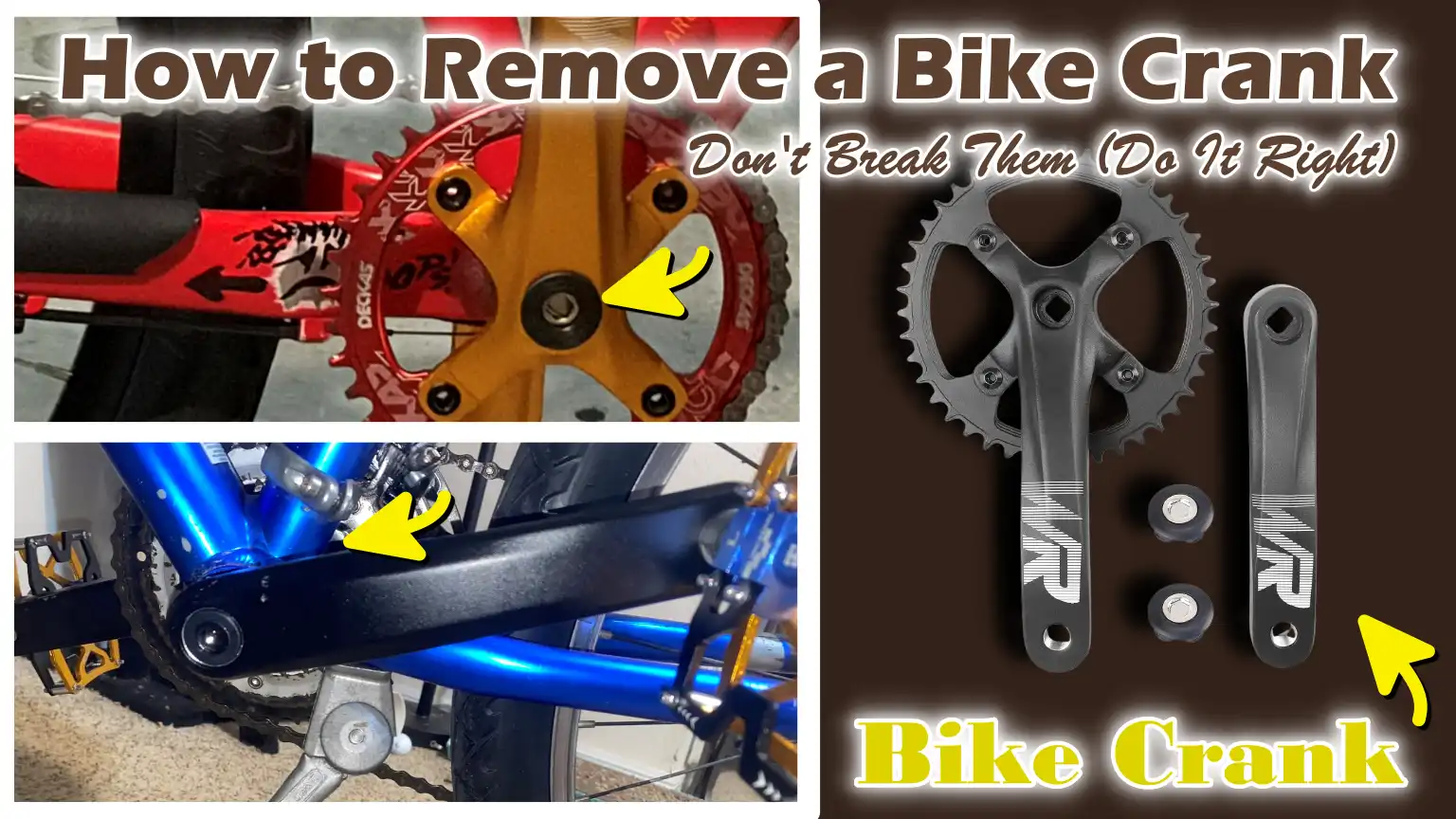
So, in this guide you’ll learn How to Remove a Bike Crank, as we have included warning signs, problem causing factors and beginner friendly method that works every time.
Know, The Types of Bike Cranks – What to Know Before You Start
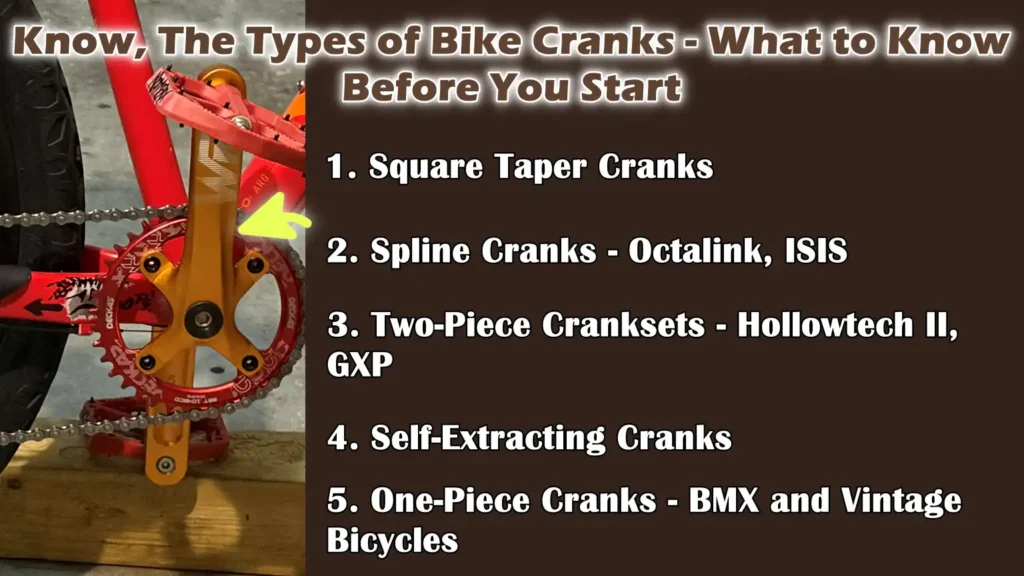
1. Square Taper Cranks
Square taper cranks are one of the oldest and most common crank designs, particularly on entry-level, vintage and many commuter bicycles.
In this system, the ends of the bottom bracket spindle feature a square-shaped taper; the crank arm slides onto this taper and is secured in place by a bolt or nut.
As the bolt is tightened, the crank arm seats firmly onto the spindle, creating a secure fit.
However, over time, the joint may loosen slightly due to the repetitive forces of pedaling, potentially resulting in creaking noises, wobbling, or visible gaps.
This is why a crank puller tool is typically required to remove square taper cranks, as the arm is pressed tightly onto the tapered spindle.
If you attempt to force it off without the correct tool, you can easily strip the threads or permanently damage the crank arm.
Understanding this type is important because it is simple, durable and very common; however, it also requires careful removal to avoid damaging the tapered interface.
2. Spline Cranks – Octalink, ISIS
Spline crank systems—such as Octalink and ISIS—were developed to offer improvements over square taper designs in terms of strength and power transfer.
Instead of a square shape, these cranks utilize multiple splines (or ridges) on the spindle that interlock with corresponding grooves inside the crank arm.
This increases the surface area of the contact interface, which helps to distribute pedaling forces more evenly and reduce wear.
Riders often face these cranks on mid-range models of older-generation mountain and road bikes.
Although they differ internally, the removal process is identical to that of square taper cranks and typically requires a crank puller as well.
The key difference is that the splined interface provides a much firmer grip; this means that if the cranks haven’t been removed for a long time, there is a slightly higher likelihood of them becoming seized.
Identifying splined cranks helps you select the correct puller tool, ensuring that you apply steady pressure and avoid damaging the internal splines.
3. Two-Piece Cranksets – Hollowtech II, GXP
Two-piece cranksets are widely used on modern road bikes, mountain bikes and performance bicycles.
In this design, the right crank arm and the spindle are permanently bonded together to form a single unit, while the left crank arm clamps onto the spindle.
Systems such as Hollowtech II and GXP rely on external bottom bracket bearings and pinch bolts rather than a crank puller.
This means that, compared to older designs, removing them is generally easier and faster.
Riders often find that these systems offer smoother pedaling and improved durability, as the hollow spindle reduces weight while maintaining structural rigidity.
To remove these cranks, you typically loosen the pinch bolts, remove a preload cap and pull the arm off by hand.
However, following the correct sequence is crucial, as attempting to forcibly remove the arm without properly loosening the bolt can damage the clamping mechanism.
Understanding this type of system allows you to avoid the unnecessary use of a crank puller and prevents errors during the removal process.
4. Self-Extracting Cranks
Self-extracting cranks are designed to simplify the removal process, as the extraction mechanism is built directly into the crank arm itself.
These cranks feature a special cap positioned around the crank bolt; when you loosen the bolt, it exerts pressure against this cap, causing the crank arm to automatically disengage from the spindle.
This eliminates the need for a separate crank puller tool.
This convenient design is commonly found on many high-end bicycles and certain modern cranksets.
Riders often appreciate its simplicity; however, complications can arise if the cap becomes loose or goes missing, as the self-extracting function will then cease to work.
In such a scenario, the crank functions just like a standard crank and additional tools may be required to remove it.
Identifying self-extracting cranks is essential, as attempting to use a standard crank puller on them can damage the integrated extraction mechanism.
With the right knowledge, you simply loosen the bolt and let the system do the rest.
5. One-Piece Cranks – BMX and Vintage Bicycles
One-piece cranks are typically found on BMX bikes, children’s bicycles and many older (vintage) bikes.
Unlike modern multi-piece designs, this crank is constructed from a single, continuous piece of metal that passes through the bottom bracket shell in an ‘S’ shape.
The bearings are installed directly inside the frame and the crank rotates as a single unit.
Due to this design, the removal method differs significantly from other types of cranks and does not require a crank puller.
Instead, you remove the bearing hardware—specifically the locknut and washer—and then pull the entire crank assembly out of the frame.
These cranks are known for their simplicity and durability, although they are heavier and less efficient compared to modern systems.
Recognizing a one-piece crank helps avoid confusion and saves you from searching for tools that are not required.
Understanding its construction also makes the removal process more straightforward and less difficult.
Tools
| Tool Name | Why It Is Needed | How To Use It |
|---|---|---|
| Crank puller tool | This tool safely separates the crank arm from the spindle. Bike cranks are fitted very tightly and attempting to remove them by hand may strip the threads or warp the components. This tool prevents costly damage and facilitates the controlled removal of the crank. | First, remove the crank bolt. Fully insert the outer body of the tool into the crank arm. Then, turn the inner bolt of the tool clockwise. The tool will gradually apply pressure against the spindle, causing the crank arm to slide off. |
| Allen wrench / hex key | Most modern crank bolts feature hexagonal (six-sided) heads. You must remove this bolt before attempting to extract the crank. Without removing it, the crank will remain stuck in place. | Insert the correct size hexagonal key (Allen key) into the crank bolt. Turn it anti-clockwise to loosen it. Before proceeding with other tools, ensure that the bolt has been completely removed. Keep the tool aligned straight to prevent stripping or damaging the bolt. |
| Socket wrench | Some bicycles utilize a nut instead of a hexagonal bolt. A socket wrench provides a firm grip and superior leverage, making it easier to loosen tight nuts. | Select the correct size socket. Fit it onto the crank nut. Apply steady pressure and turn anti-clockwise. Ensure that the nut has been completely removed before proceeding further. |
| Rubber mallet – Optional | Occasionally, the crank may become seized due to dirt or rust accumulation. A rubber mallet helps to gently loosen the crank without causing scratches or marks on the components. | Once the crank has loosened, gently tap around the crank arm. Apply only light taps; do not strike it forcefully. This method allows even a slightly seized crank to be removed with ease. |
| Bottom bracket tool – If Required | This tool is required only if you wish to remove or inspect the bottom bracket after removing the crank. It aids in checking for worn-out bearings or resolving noise-related issues. | After removing the crank, insert the tool into the bottom bracket cup. Use a wrench to gently turn it. Ensure that you are turning it in the correct direction, as this depends on the specific side. Remove the component only when absolutely necessary. |
| Grease or anti-seize compound | This helps prevent metal components from seizing together in the future. It reduces noise, protects the threads and makes it easier to remove the parts the next time around. | Before reinstalling the crank, apply a thin layer of this substance to the threads of the spindle and bolts. Do not apply an excessive amount. Spread it evenly using your finger or a cloth. |
| Clean cloth | This keeps the components clean and helps you identify any signs of damage or wear. Dirt can hide cracks and lead to errors during reinstallation. | Wipe down and clean the crank arm, the spindle and the surrounding area—both before and after removing them. Use this method to remove old grease and accumulated dirt. Before reinstalling the parts, ensure that they are thoroughly clean. |
Ensure Safety By Taking Necessary precautions
1. Shift the Chain to the Smallest Chainring
Before removing the bike’s crank, it is essential to shift the chain to the smallest chainring.
This simple step reduces chain tension and provides more clearance to work around the crank.
When the chain is on a larger chainring, it is under greater tension and sits closer to the crank arm, increasing the risk of scraping your fingers or snagging the chain while removing the crank.
Positioning the chain on the smallest ring also minimizes the risk of the chain suddenly shifting or slipping while you are loosening the bolts.
This is particularly helpful for beginners, as a slack chain provides a clear view of the crank and makes it easier to safely position your tools correctly.
It also helps prevent grease from the chain from getting onto your hands and tools.
Taking a few seconds to shift gears can help prevent minor injuries and ensures that the crank removal process remains more controlled.
2. Securely Stabilize the Bike
Ensuring the bike is stable is crucial for safely removing the crank, as applying force to bolts or tools can cause the bike to wobble or tip over.
If the bike shifts unexpectedly, tools may slip—potentially damaging bike components or causing personal injury.
The best approach is to mount the bike on a repair stand, which keeps it stable and provides easy access to the crank.
If a stand is unavailable, the bike can be securely leaned against a wall or even inverted for the work, provided it remains completely steady and does not move.
When using a crank puller or loosening tight bolts, ensuring the bike remains stable becomes even more critical, as these tasks require the application of sustained force.
With a properly stabilized bike, you can apply force directly and efficiently; this safeguards the threads and eliminates the risk of tools slipping.
Keeping the bike steady makes the entire process safer, more precise and less stressful.
3. Wear Gloves – Optional, but Helpful
Wearing gloves is not strictly mandatory, but it offers several practical advantages when removing a crank.
Bicycle components often feature grease, grime and sharp edges, which can make them difficult to grip.
Wearing gloves improves your grip, preventing tools from slipping while you are loosening bolts.
They also protect your hands from injuries caused by chainring teeth, sharp metal edges, or sudden tool movements.
Another benefit is that gloves keep your hands clean, making it easier to handle small components—such as bolts and washers—without dropping them.
Even lightweight work gloves can make a significant difference, specially when you are applying force or working with a component that is stuck.
Although not strictly essential, gloves add an extra layer of safety and comfort throughout the entire process.
4. Do Not Force Components
One of the most important safety rules when removing a bike crank is to never force any component.
Bike cranks are designed to fit precisely; however, applying excessive pressure can strip the threads, bend the crank arms, or damage the bottom bracket.
If a part does not move easily, it generally indicates that a bolt remains in place, the tool is not properly seated, or movement is being obstructed by dirt and rust.
Rather than applying sudden force, it is always safer to exert slow and steady pressure.
Checking the alignment and ensuring that the correct tools are being used will often resolve the issue without any risk.
For parts that are difficult to loosen, it is better to use a penetrating oil or gently reseat the tool rather than applying excessive force.
Exercising patience protects expensive components and ensures that the crank can be removed smoothly without creating any new problems.
How to Remove a Bike Crank – Easy & Effective Method
1. Position the Bike Correctly
The first step in removing a bike’s crank is to position the bike in such a way that it remains stable and is easy to work on.
Proper positioning is crucial because you will be applying force to bolts and tools; even the slightest movement could cause tools to slip, result in injury, or damage the bike’s components.
Using a bike repair stand is the best approach, as it holds the bike upright and positions the crank area at a comfortable working height.
This allows you to clearly view the crank and apply direct, controlled force while loosening the bolts.
If a repair stand is unavailable, inverting the bike is a common alternative.
When doing so, ensure that the bike rests securely on its saddle and handlebars and verify that it does not wobble or slide.
When positioning the bike upside down, you may also wish to remove accessories—such as lights or cycling computers—to prevent them from being damaged.
Correct positioning also keeps the drivetrain stable, making it easier to remove the crank bolts and properly engage your tools.
Taking a moment to secure the bike before beginning the work minimizes errors, enhances safety and ensures that the entire crank removal process is completed more smoothly and with greater control.
2. Remove the Crank Bolt or Nut
Locate the Crank Arm Bolt
The first part of this step is to identify the crank arm bolt or nut, which is situated at the center of the crank arm where it connects to the bike’s spindle.
This bolt securely holds the crank arm in place and it is essential to remove it completely before attempting to pull the crank off.
On most bicycles, the bolt is clearly visible; however, on some models, it may be hidden beneath a plastic or metal dust cap, which must first be gently removed.
Taking a moment to precisely locate the bolt helps avoid confusion and eliminates the risk of accidentally loosening the wrong component.
It is also helpful to wipe away any surrounding dirt or grease to ensure that the tool fits properly.
Knowing exactly where the bolt is located—and ensuring it is clean—allows you to apply force safely, minimizing the risk of slipping or damaging the bolt head.
Use the Correct-Sized Hex Key or Socket
Once the bolt or nut has been located, selecting the correct tool size is crucial.
Most modern crank bolts utilize a hex key, while some older designs feature nuts that require a socket wrench.
Using the correct size ensures that the tool fits snugly and prevents the edges of the bolt from becoming rounded off.
If the tool is too small, it can strip the internal mechanism of the bolt, making it extremely difficult to remove.
Conversely, if it is too large, it will not fit properly and may slip.
Before applying any force, fully insert the hex key or socket into the bolt to ensure it is securely seated.
Keeping the tool straight and properly aligned with the bolt also helps distribute the force evenly.
This careful approach protects the bolt and ensures that it can be removed without sustaining any damage.
Rotate Anti-Clockwise
Once the tool is properly seated, rotate it in a anti-clockwise direction to loosen the bolt or nut.
This direction is standard for most bike crank bolts, adhering to the general rule of “lefty-loosey.”
Apply force gradually and steadily rather than abruptly, as controlled movements reduce the likelihood of slipping.
If the bolt feels tight, maintain consistent pressure and avoid jerking the tool.
It is normal for the bolt to be tight, specially if the crank has not been removed for a long time.
As soon as the bolt begins to turn, continue rotating it until it is completely separated from the crank arm.
It is crucial to remove it entirely; if the bolt remains even slightly engaged, the crank will not be able to come off.
This step prepares the crank arm for safe removal using the correct extraction method.
3. Thread the Crank Puller Tool
Carefully insert the tool into the crank threads.
After removing the crank bolt, the next step is to insert the crank puller tool into the threaded hole of the crank arm.
These threads are specifically designed for the puller tool and facilitate the safe removal of the crank arm.
It is crucial to position the tool gently and begin threading it slowly, as the crank threads are relatively soft and can be damaged if excessive force is applied to the tool.
Dirt or old grease inside the threads can also obstruct the insertion of the tool; therefore, cleaning the area beforehand ensures that the tool threads in smoothly.
When inserted correctly, the tool should turn easily without any significant resistance.
Starting slowly ensures that the threads engage properly and helps prevent “cross-threading” (incorrect threading), which can permanently damage the crank arm and make its removal extremely difficult.
First, tighten fully by hand.
Before using any wrench or applying additional force, it is essential to fully tighten the crank puller tool by hand.
This step ensures that the outer body of the tool is seated deeply within the threads of the crank arm.
If the tool is not threaded in deeply enough, the pressure applied during the crank removal process can strip the threads and ruin the crank.
Turning the tool by hand provides better control and allows you to feel whether it is threading in smoothly.
You should continue tightening until the tool stops on its own and feels securely seated.
This precautionary step of hand-tightening is one of the most critical parts of safely removing a crank, as it ensures that the tool has sufficient grip to withstand the force required to push the crank out.
Ensure It Is Straight
Once the tool has been threaded in, it is crucial to verify that it is perfectly straight and aligned with the crank arm.
Proper alignment ensures that the pushing force is applied evenly to the spindle, allowing the crank to slide out smoothly.
If the tool is at an angle or slightly crooked, it can damage the threads, slip during use, or exert uneven pressure.
This can result in stripped threads or bent components.
Viewing the tool from the side and making adjustments as needed helps confirm proper alignment.
Once the tool is straight and fully threaded, it is ready for the next step—the stage where the crank arm will be safely removed by turning the inner bolt of the crank puller.
4. Remove the Crank Arm
Turn the Crank Puller Handle Clockwise
Once the crank puller tool is fully tightened into the crank arm, the removal process begins by turning the inner handle or bolt of the crank puller in a clockwise direction.
This inner bolt exerts pressure against the bottom bracket spindle, while the outer body of the tool holds the crank arm firmly in place.
As you turn it clockwise, the tool gradually builds outward pressure, causing the crank arm to move away from the spindle.
This controlled mechanical action is far safer than attempting to pull it off by hand, as it applies force directly and evenly along the axis of the crank.
When performing this step, it is crucial to turn slowly and keep the tool aligned straight.
Turning too quickly or at an angle can cause the tool to slip or create uneven pressure, increasing the risk of damaging the threads.
A steady clockwise motion ensures that the crank arm begins to loosen gradually, without any sudden jolts.
Maintain Steady Pressure
Maintaining steady and consistent pressure is essential when removing a crank.
Bike cranks are designed to fit tightly onto the spindle, so it is normal to feel some resistance while turning the tool.
Rather than applying sudden, forceful jerks, maintain a smooth and steady pressure.
This allows the tool to work effectively without placing unnecessary strain on the metal components.
If the crank has not been removed for a long time, it may feel somewhat stuck due to accumulated dirt, rust, or excessive tightness.
In such cases, patience is key.
Maintaining steady pressure helps the tool gradually break the bond formed between the crank arm and the spindle.
Avoid using jerky movements or applying excessive force, as this could damage the threads or ruin the crank puller.
A calm and controlled approach helps ensure that the crank is extracted safely.
The Crank Arm Will Separate from the Spindle
As you continue to turn the tool and apply steady pressure, the crank arm will gradually slide outward and eventually separate from the spindle.
This is often accompanied by a faint ‘pop’ (or ‘thud’) sound, or a sudden sensation of the component coming loose, indicating that the crank has disengaged from the spindle.
This is completely normal and expected.
Once the crank arm is loose, you can stop turning the tool and pull the crank off by hand.
It is important to support the crank arm while removing it to prevent it from falling or getting scratched.
After removing the crank, you can inspect the interface between the spindle and the crank for any dirt, wear, or damage.
With the completion of this step, the main crank removal process is finished and you are ready to use the same method to remove the crank arm on the other side.
5. Repeat the Same Process on the Other Side
Follow the Same Procedure
After removing the first crank arm, the next step is to repeat the exact same removal process on the other side.
Bicycle cranks are designed in pairs; therefore, if you require full access to the spindle or bottom bracket, it is essential to remove the cranks on both sides.
The procedure remains exactly the same, ensuring consistency and avoiding any confusion.
First, verify that the chain is not obstructing the second crank arm—particularly on the drive side, where the chainrings are attached.
Next, locate the crank bolt or nut, remove it using the appropriate tool and carefully thread the crank puller into the threads of the crank arm.
Adhering to this same careful approach ensures that the crank on the second side is removed just as safely and securely as the first.
Repeating this process slowly and systematically helps prevent errors specially as the drive-side crank may feel slightly tighter due to the weight of the chainrings and accumulated grime.
Remove the Second Crank Arm
Once the crank puller is securely tightened, turn the handle clockwise and continue applying steady pressure until the second crank arm begins to slide outward.
Just like on the first side, the crank arm will gradually loosen and then separate from the spindle.
Supporting the crank arm as it detaches prevents it from falling to the ground and helps protect the chainrings from scratches.
Once the second crank arm has been completely removed, the bottom bracket spindle and the entire surrounding area become fully exposed, making inspection and cleaning significantly easier.
At this stage, you can check for wear, dirt accumulation, or any other defects that might be causing noise or causing the crank to loosen.
Completing the process of removing the cranks from both sides ensures that the crankset is fully disassembled and is now ready for repair, replacement, or reinstallation.
How to Remove Self-Extracting Cranks
1. Identify the Self-Extracting Cap
Self-extracting cranks are designed with a built-in removal system, making them easier to remove compared to traditional crank types.
The key feature to look for is a circular cap located at the center of the crank arm, which surrounds the crank bolt.
This cap is typically threaded into the crank and remains stationary even as the internal bolt moves.
When identifying this type, you will notice that the crank bolt sits inside a larger ring rather than being directly exposed.
This outer ring is the self-extracting cap and it plays a crucial role during the removal process.
It acts as a surface against which the bolt exerts pressure, thereby causing the crank arm to extract itself.
Before you begin, it is helpful to confirm that this cap is securely tightened and properly seated; if it is loose or missing, the self-extracting feature will not function correctly.
Identifying this cap helps avoid the unnecessary use of a crank puller and ensures that you follow the correct removal method.
2. Loosen the Center Bolt
Once the self-extracting cap has been identified, the next step is to loosen the center bolt using an appropriately sized hex key.
Unlike standard crank removal procedures, you do not remove the outer cap—you only loosen the inner bolt.
As you turn the bolt anti-clockwise, it begins to retract, exerting pressure against the stationary cap.
This generates an outward force that gradually separates the crank arm from the spindle.
It is crucial to turn the bolt slowly and apply steady pressure, as the built-in system relies on smooth motion to function correctly.
If the bolt feels tight, this is normal, as it is actively working to pull the crank arm outward.
Keeping the tool aligned straight and maintaining consistent pressure helps prevent slippage and protects the bolt head from damage.
This simple step eliminates the need for a separate crank puller tool.
3. The Crank Arm Detaches Automatically
As you continue to loosen the center bolt, the self-extracting mechanism gradually pushes the crank arm away from the spindle.
As the crank arm begins to move outward, you may feel increasing resistance, followed by a sensation of slight loosening.
This is expected and indicates that the system is functioning correctly.
Eventually, the crank arm will completely detach from the spindle, while the bolt remains seated within the crank itself.
This self-extraction method expedites the process and minimizes the risk of damaging the threads.
Once the crank arm is loose, you can remove it by hand and inspect the spindle and contact surfaces for any dirt or signs of wear.
Supporting the crank arm while removing it prevents it from falling and protects other components from scratches.
In this way, the process of removing a self-extracting crank is completed safely and efficiently.
How to Remove a Two-Piece Crankset – Hollowtech-Style
1. Remove the Preload Cap
In a two-piece crankset, a preload cap is used to control the tension on the bearings and ensure that the crank remains properly aligned.
This cap is typically located on the left crank arm and is often made of plastic or a lightweight alloy.
Its primary purpose is not to hold the crank tightly in place, but rather to eliminate any lateral play (side-to-side looseness) before the pinch bolts are tightened.
To begin the removal process, it is first necessary to loosen and remove the preload cap.
This task is typically performed using a small hex key or, depending on the design, a specialized plastic tool.
It is crucial to turn it gently, as this cap is designed for only light tension and applying excessive force can damage its threads.
Once removed, the preload on the crank arm is released, allowing it to be easily pulled off during the subsequent steps.
Properly removing the preload cap reduces pressure on the bearings and ensures that the crank can be extracted with ease.
2. Loosen the Pinch Bolts
After removing the preload cap, the next step is to loosen the pinch bolts located on the side of the left crank arm.
These bolts firmly clamp the crank arm onto the spindle, securely holding it in place while riding.
Most two-piece cranksets feature two pinch bolts, which should be loosened simultaneously and evenly.
Loosening them gradually and alternately ensures that the clamping pressure is reduced evenly, thereby preventing damage to the clamping mechanism.
It is not necessary to remove these bolts completely; they simply need to be loosened enough to release their grip on the spindle.
Using a hex key of the correct size and applying even pressure minimizes the risk of damaging the bolt heads.
Once loosened, the crank arm should feel less rigid and be ready to slide out.
3. Remove the Crank Arm
With the preload cap removed and the pinch bolts loosened, the left crank arm can now be pulled off the spindle.
This typically requires nothing more than a gentle pull by hand.
As two-piece cranksets are not “press-fit” like older designs, they generally slide off without requiring excessive force.
If the crank arm feels slightly stuck, gently rocking it from side to side while pulling outward will help it slide off easily.
Avoid applying excessive force, as the spindle and bearings are precision-engineered and delicate components.
Removing the crank arm exposes the spindle and prepares the crankset for complete removal.
Supporting the crank arm while removing it prevents it from falling and helps protect its finish.
4. Remove the Spindle and Chainrings
After removing the left crank arm, the right side of the crankset—which includes the spindle and chainrings—can be pulled out of the frame.
In a two-piece design, the spindle is permanently attached to the right crank arm, so the two components come out together.
Gently pull the crankset out of the bottom bracket shell, supporting the chainrings to ensure they do not scratch the frame.
Sometimes, giving the crank a slight twist while pulling helps the spindle slide out of the bearings more easily.
Once removed, you will have full access to clean or inspect the bottom bracket bearings.
This final step completes the process of removing a two-piece crankset, allowing for maintenance, replacement, or reinstallation.
How to Remove a One-Piece Crank – Older Bicycles
1. First, Remove the Pedals
One-piece cranks are typically found on older bicycles, BMX bikes and many children’s bikes.
They consist of a single, continuous metal rod that passes through the bicycle’s frame.
Before removing this type of crank, it is essential to remove the pedals first, as they protrude outward and can prevent the crank from sliding out.
The pedals are threaded into the crank arms; removing them provides more working space and prevents damage while pulling the crank out of the frame.
It is crucial to remember that the pedal threads have specific directions: the left pedal loosens when turned clockwise, while the right pedal loosens when turned anti-clockwise.
Using the correct wrench and applying steady pressure helps prevent damage to the threads.
Once both pedals have been removed, handling and rotating the crank assembly becomes much easier during the removal process.
2. Remove the Locknut
After removing the pedals, the next step is to remove the locknut located on the threaded section of the crank assembly.
This locknut secures the bearing adjustment in place and prevents the crank from shifting.
It is typically located on the left side of the bicycle and a wrench may be required to loosen it.
Turning the locknut gradually prevents it from coming loose abruptly and ensures that the small components remain organized.
Removing this locknut is essential, as it releases the tension on the bearing system; without removing it, the crank cannot slide out of the frame.
During this stage, paying close attention to the specific order of the washers and spacers will be helpful for correctly reassembling the components later on.
3. Remove the Bearing Hardware
Once the locknut has been removed, the bearing hardware can be taken off.
This includes a washer, a bearing retainer and—sometimes—a threaded cone that adjusts the bearing tension.
These components support the crank as it rotates inside the frame.
Carefully removing them allows the crank to spin freely.
It is helpful to keep these parts in order as you remove them so that they can be correctly reinstalled later.
Dirt and old grease often accumulate in this area; therefore, cleaning the hardware while removing it makes the entire process much easier.
Completely removing the bearing hardware clears the path, allowing the crank to slide out without any obstruction.
4. Pull Out the Crank
Once all the hardware has been removed, the one-piece crank can be pulled out of the frame.
As it is a single, continuous piece, it must be rotated as it is guided through the bottom bracket shell.
By gently pulling and rotating the crank, you can extract it from the frame without scratching or damaging it.
Supporting the crank while removing it prevents it from dropping, thereby protecting both the chainring and the frame from potential damage.
Once removed, the bearings located inside the frame become visible, making it possible to clean or inspect them.
This final step completes the crank removal process and provides full access for maintenance, lubrication, or the replacement of worn-out parts.
Common Mistakes to Avoid During Removal of a Bike Crank
1. Failing to Remove the Crank Bolt First
One of the most common mistakes made when removing a bike crank is forgetting to remove the crank bolt or nut before using the crank puller.
The crank bolt holds the crank arm tightly onto the spindle; if it is left in place, the crank cannot be extracted.
Beginners sometimes begin turning the crank puller while the bolt is still slightly tightened, creating excessive pressure inside the crank arm.
This can result in damage to the crank puller, stripped threads, or even a broken crank arm.
Completely removing the bolt ensures that the puller has sufficient clearance to apply direct pressure against the spindle.
Spending a few extra seconds to double-check that the bolt has been fully removed can prevent unnecessary damage and make the crank removal process significantly easier.
2. Improperly Tightening the Crank Puller – Cross-threading
Cross-threading occurs when the crank puller is inserted at an angle and its threads do not align correctly.
This is a serious issue because the internal threads within the crank arm are relatively soft and can be permanently damaged if subjected to force.
If the threads become stripped, the crank puller cannot establish a proper grip, making it extremely difficult to remove the crank.
To avoid this, the tool should always be tightened slowly by hand first.
If immediate resistance is felt, it indicates that the tool is not seated correctly.
Loosening it slightly and starting over ensures that the tool is properly engaged.
A properly seated crank puller should turn smoothly and remain aligned.
By avoiding cross-threading, the crank arm remains protected and can be safely removed.
3. Using the Wrong-Sized Tool
Using an incorrectly sized hex key, socket, or crank puller is another common mistake that results in damage to both the bolt and the tool.
If the hex key is too small, it can round off the internal edges of the crank bolt, making it difficult to remove.
If it is too large, it will not fit properly and may slip.
Similarly, using the wrong type of crank puller prevents the threads from engaging fully.
Always verify the tool size before applying force; this prevents the tool from slipping and minimizes the risk of damaging the hardware.
Using the correct tool size allows you to apply uniform pressure, ensuring that the bolts or threads remain in good condition for future use.
4. Applying Excessive Force
When a crank becomes stuck, a common mistake is to apply excessive force.
Bicycle components are designed to be removed using controlled pressure, rather than through sudden or forceful manipulation.
Applying too much force can bend the crank puller, strip the threads, or even damage the bottom bracket bearings.
If the crank does not move easily, it indicates that something is not seated correctly—such as incomplete threading or trapped debris.
Applying slow and steady pressure allows the tool to perform its function effectively.
Patience is crucial, as gradually increasing the pressure ensures that the crank separates safely from the spindle without damaging any components.
Refraining from applying excessive force ensures that the structural integrity of the crank and its surrounding components remains intact.
5. Forgetting to Remove the Washer Behind the Bolt
In certain crank setups, a small washer is positioned behind the crank bolt or nut.
This washer helps distribute pressure evenly and protects the surface of the crank.
If you forget to remove this washer before using a crank puller, the tool will not seat properly in its designated position.
When the puller fails to seat deeply enough, the threads may become damaged, or the tool could slip during the extraction process.
Occasionally, the washer becomes lodged inside the crank arm and goes unnoticed.
Carefully inspecting the area after removing the bolt ensures that nothing has been left behind.
Once the washer has been completely removed, the crank puller can be fully threaded into place, allowing it to function exactly as intended.
How to Fix a Stuck Crank
1. Apply Penetrating Oil
When a crank arm ceases to rotate, the cause is often dirt, rust, or dried grease that has bonded the metal surfaces together.
Applying penetrating oil helps loosen this joint by seeping into the tiny crevices between the crank arm and the spindle.
These oils are formulated to dissolve rust and reduce friction, thereby facilitating the removal of the crank.
To use it effectively, apply a small amount of oil around the joint where the crank meets the spindle.
Allowing the oil to sit for a few minutes gives it time to penetrate deeply.
If the crank is severely stuck, waiting for a longer duration will yield better results.
Wiping away any excess oil afterward prevents it from spreading onto braking surfaces or other components.
This simple step can significantly alleviate the obstruction and eliminate the need to apply excessive force.
2. Gently Tap with a Rubber Mallet
If the crank remains stuck even after applying penetrating oil, gently tapping it with a rubber mallet can help loosen it.
A rubber mallet is preferred because it delivers a mild shock without damaging the surface of the crank.
The objective of tapping is not to force the crank off, but rather to generate small vibrations that help break the bond between the crank arm and the spindle.
Gently tapping around the crank arm—particularly near the spindle—is usually sufficient.
It is crucial to tap gently and in a controlled manner, as sharp, forceful blows can damage the bearings or warp the components.
Once the crank puller is properly seated, gently tapping the crank increases the likelihood of safely dislodging it.
3. Retighten and Try Again
Occasionally, loosening and then retightening the crank puller helps to extract a stuck crank.
This method works because slightly tightening the tool allows it to seat properly within the threads, ensuring a complete and secure engagement.
Once retightened, applying pressure again allows the tool to exert force on the spindle in a more uniform manner.
This process can be repeated carefully, gradually increasing the pressure each time.
The objective is to apply force in controlled increments rather than exerting full force all at once.
This approach minimizes the stress placed on the crank and prevents damage to the threads.
Taking the time to reset the tool also ensures that it remains straight and properly aligned.
4. Use a Longer Wrench for Greater Leverage
If the crank remains stubbornly stuck despite sustained pressure, using a longer wrench can provide the necessary extra leverage.
A longer handle offers greater mechanical advantage, allowing you to apply more—yet still controlled—force without overexerting yourself.
This is particularly helpful when dealing with cranks that were installed very tightly or have remained untouched for a long period.
When using a longer wrench, it is essential to apply pressure slowly and steadily rather than making sudden or jerky movements.
This keeps the force under control and minimizes the risk of slippage.
When the correct amount of force is applied, the crank puller operates more effectively, while also reducing the risk of damage to the threads or tools.
How to Clean and Inspect After Removal
Not only this, there’s research on crank torque symmetry that shows that uneven force between legs can literally reduce the cycling efficiency and increases the strain on the components, so by removing the crank periodically, you can clean the contact surfaces and reinstall it in a correct way that actually helps the riders to maintain the proper alignment and improve the overall power transfer as well, so this maintenance step supports smoother pedaling and reduces the unnecessary mechanical stress as well.[¹]
1. Cleaning the Crank Arms
After removing the crank arms, cleaning them is a crucial first step before proceeding with inspection or reinstallation.
Dirt, old grease and fine metal particles often accumulate on the internal surfaces that come into contact with the crank and spindle.
This debris can obscure signs of wear or interfere with proper seating during reassembly.
Wiping the crank arms with a clean cloth removes loose dirt, while mild degreasers can help dissolve stubborn grease.
Cleaning allows for a clear visual inspection of the contact surfaces and threads.
A clean crank arm facilitates accurate inspection and minimizes the risk of introducing dirt into the bottom bracket during reassembly.
Keeping this component clean ensures sustained performance over time and prevents the creaking noises often caused by contamination.
2. Inspecting the Spindle for Wear
The spindle is the central shaft that connects the two crank arms and is constantly subjected to the forces of pedaling.
After removing the cranks, carefully inspect the surface of the spindle for signs of wear.
Check for flattened areas, scratches, or rough metal surfaces; these marks may indicate that a crank arm had come loose while riding.
Excessive wear can compromise the crank’s fit, potentially causing it to loosen repeatedly even after reinstallation.
Gently running a finger over the spindle helps detect rough spots that may not be immediately visible to the naked eye.
If the spindle appears excessively worn, it may be necessary to replace it to ensure proper functionality.
Timely inspection of the spindle helps prevent future issues with crank instability and improves pedaling efficiency.
3. Inspect the Condition of the Bottom Bracket
Once the crank has been removed, the bottom bracket becomes accessible for inspection.
This component houses bearings that facilitate the smooth rotation of the crankset.
Rotate the spindle or bearings by hand to check if they spin freely.
Friction, resistance to rotation, or any unusual noises may indicate that the bearings are worn out or have become contaminated with dirt.
Additionally, check for any side-to-side movement; this could be a sign that a component has come loose or is damaged.
Dirt and moisture often accumulate around the bottom bracket, so cleaning this area helps maintain optimal performance.
Identifying issues at this stage allows you to repair or replace the bottom bracket before reinstalling the crank, thereby avoiding the need for repeated removal later on.
4. Check for Cracks or Damage
Carefully inspect the crank arms and surrounding components for cracks, blemishes, or structural damage.
Small cracks often appear near the pedal threads, bolt holes, or the spindle interface—areas where stress is most concentrated.
Over time, even minor cracks can propagate and lead to sudden component failure while riding.
Furthermore, check for worn threads or any deformation caused by improper removal techniques.
Under good lighting, fine lines or unusual marks on the metal surface are easily visible.
If any damage is detected, it is safer to replace the affected part rather than repairing it.
This inspection process ensures the structural integrity of all components prior to reassembly and helps prevent unexpected issues during future rides.
How to Prepare for Reinstallation of a Bike Crank Removal
1. Apply Grease to the Spindle
Before reinstalling the crank arms, it is crucial to apply a thin layer of grease to the spindle to ensure smooth operation and longevity.
The interface between the spindle and the crank is a point of metal-to-metal contact; without proper lubrication, friction can lead to wear and tear, creaking noises and difficulty in removal in the future.
A light coating of bicycle-specific grease helps prevent corrosion caused by moisture and dirt—particularly when riding in humid or wet conditions.
It also facilitates the crank arm sliding smoothly onto the spindle, ensuring a proper and secure fit.
Only a very small amount of grease is required, as applying too much can cause dirt and dust to accumulate.
Spreading the grease evenly with a finger or a clean cloth ensures complete coverage without any excessive buildup in specific spots.
Proper lubrication enhances the bicycle’s performance and simplifies future maintenance.
2. Cleaning the Threads
Prior to reinstallation, it is essential to clean the threads on both the crank bolts and the crank arms.
During removal, dirt, old grease and minute metal particles can accumulate within the threads, preventing the bolts from tightening correctly.
Dirty threads result in inconsistent torque application, which can lead to the crank arms coming loose or the threads becoming damaged.
Wiping the threads with a clean cloth removes debris and allows the bolts to turn freely.
If old grease has dried and hardened, a mild degreaser can be used to thoroughly clean the area.
After cleaning, the threads should appear smooth and completely free of dirt.
When the threads are clean, the bolts tighten evenly and securely; this maintains the alignment (straightness) of the crank and ensures it does not loosen while cycling.
3. Properly Align the Crank Arms
Correct alignment of the crank arms is crucial for safe and efficient pedaling.
The left and right crank arms should be positioned directly opposite each other, at a 180-degree angle.
This alignment balances the pedaling motion and prevents the body from being forced into an uncomfortable position while riding.
When installing the crank arms, carefully and correctly seat them onto the spindle before tightening the bolts.
Improper alignment leads to uneven power transfer, causes physical discomfort and results in increased wear and tear on the bicycle’s components.
Using the other crank arm as a reference point helps in achieving the correct positioning.
Once aligned, gradually tightening the bolts ensures the crank remains firmly seated in place.
Proper alignment enhances pedaling efficiency and eliminates the need for frequent readjustments later on.
Read More:
Conclusion On How to Remove a Bike Crank
You should take enough time to remove your crank in correct and safe way, otherwise it could cost a heavy cost even that extends the life of your bicycle components as well.
The crankset plays a pivotal role in transmitting your pedaling power to the drivetrain; therefore, handling it with care is essential to ensure your bike’s smooth performance and the longevity of its components.
By identifying the specific type of crank, utilizing the correct tools and following each step in the proper sequence, you minimize the risk of stripped threads, damaged bearings, or misaligned parts.
Adhering to safety precautions—such as avoiding excessive force and properly handling seized cranks—ensures that the removal process remains controlled and safe.
Cleaning and inspecting components after removal allows you to detect early signs of wear, thereby preventing major mechanical issues down the road.
When preparing for reinstallation, ensuring proper lubrication, clean threads and correct alignment not only enhances pedaling efficiency but also reduces noise.
Ultimately, carefully removing a crank involves more than just detaching parts; it is about maintaining your bike’s reliability, protecting expensive components and ensuring that every ride feels smooth and responsive.
Now, that’s it from this one and you can comment for more information related to this guide.
Frequently Asked Questions
Q1: What is a bike crank and why might I need to remove it?
Answer: A bike crank is the component that connects your pedals to the drivetrain and transfers your pedaling power to propel the bike forward. You might need to remove it for various reasons, such as fixing a creaking noise, replacing worn-out parts, cleaning the bottom bracket, upgrading your crankset, or inspecting for damage. Over time, due to dirt, moisture and repeated stress, the crank can become loose or worn. Removing it allows you to clean hidden components, diagnose issues and properly re-install it so your bike can run smoothly again.
Q2: Do I always need a crank puller to remove a bike crank?
Answer: Not all bike cranks require a crank puller. Traditional square taper and splined cranks typically require one because they sit very tightly on the spindle. However, modern two-piece cranksets and self-extracting cranks often do not require a crank puller. These designs utilize pinch bolts or internal extraction systems that allow the crank to be removed more easily. Identifying the type of crank you have before you begin helps you choose the correct removal method and avoid using unnecessary tools.
Q3: How can I determine what type of crank I have?
Answer: You can identify the type of crank you have by observing how it attaches to the bike. If you see a simple bolt in the center and no external bearings, it is often a square taper or splined crank. If the crank features external bearings situated outside the frame and pinch bolts on one of its arms, it is likely a two-piece crankset. If you observe a ring surrounding the crank bolt, it may be a self-extracting crank. Older bicycles—distinguished by a bent metal piece passing through the center of the frame—typically feature a one-piece crank. Checking for these visual cues helps determine the correct removal procedure.
Q4: Why is my crank arm stuck and won’t come off?
Answer: A crank arm can become stuck due to rust, accumulated grime, or being installed too tightly. Over time, moisture can cause metal components to seize together specially if grease was not applied during installation. The repetitive pressure exerted while pedaling can also cause the crank to seat very tightly onto the spindle. Applying penetrating oil, ensuring the crank puller is properly tightened and applying steady, consistent pressure usually resolve this issue. Avoid applying excessive force, as doing so may damage the threads or the crank arm itself.
Q5: Can I remove a bike crank without any special tools?
Answer: While it is possible to remove certain types of cranks without specialized tools, it is generally not recommended for most designs. Two-piece cranksets and self-extracting cranks can often be removed using a standard hex key. However, square taper and splined cranks require a crank puller to prevent damage. Attempting to force the crank off or striking it with a hammer can result in bent components, damaged threads, or harm to the bottom bracket. Using the correct tools makes the process safer and helps avoid costly repair expenses.
Q6: How tight should the crank bolt be when reinstalling it?
Answer: The crank bolt should be tightened firmly, but not excessively. Proper tightening ensures that the crank arm remains securely attached and does not wobble. Most manufacturers specify a specific torque value—depending on the type of crank—which typically falls within a range of moderate to firm pressure. Overtightening can strip the threads, while undertightening can cause the crank to loosen while riding. Maintaining consistent pressure and checking for proper alignment ensures that the crank is fitted correctly.
Q7: What happens if you ride a bicycle with a loose crank arm?
Answer: Riding a bicycle with a loose crank arm can cause serious damage. The looseness creates wear on the spindle and the inner surfaces of the crank arm, potentially causing permanent deformation of the metal. This damage often makes it difficult to properly tighten the crank later on. You may also face issues such as clicking noises, uneven pedaling and reduced efficiency. In severe cases, the crank arm could even snap off while riding, posing a safety hazard. Addressing any looseness immediately can prevent further damage.
References:
[1] Functional data analysis reveals asymmetrical crank torque during cycling performed at different exercise intensities
https://www.sciencedirect.com/science/article/pii/S0021929021002591

Jonathan, the passionate owner of Bicycle Time, brings a lifelong love for bikes and automotive craftsmanship, that reflects into every corner of the shop. With deep passion in both cycling and automotive accessories, Jonathan is more than just an expert.