 Skip to content
Written By: Jonathan
Fact Checked By: Caroline Dezendorf
Reviewed By: Matt Tanner
Clearly, a Jeep Wrangler is built for having a unforgettable adventures, so does the truly compatible bike rack make sure that your bikes can join that as well.
Also, Jeep Wrangler comes with its unique rear-spare-tire design and is often used for off-road travel, which is why you need something that perfectly fits in it without compromising security and stability at all.
Plus, a high-quality rack also ensures to transport your beloved bicycles in the most secure way possible.
Not only this, we have included these 5 Best Bike Rack for Jeep Wrangler that protects both the vehicle and bike frame, also because of the compatibility it provides safety locks, vibration control and adjustable clearance so that you can easily load and unload the bikes.
What are The Types of Bike Racks Compatible with the Jeep Wrangler
Choosing the right type of bike rack for a Jeep Wrangler is crucial due to the vehicle’s unique rear design, which features a swing gate and an externally mounted spare tire.
The wrong rack can obstruct visibility, hinder tailgate access, or fail to adequately support the weight of the bikes, specially during off-road travel.
There are four main types of racks that work with the Wrangler: spare tire-mounted, hitch-mounted, roof-mounted, and trunk-style racks.
Each type of rack operates differently, supports varying bike weights, and is suited to specific driving conditions.
Understanding these differences allows Jeep owners to select a rack that is easy to install, safe to use, and durable enough for both everyday driving and challenging outdoor adventures.
1. Spare Tire-Mounted Bike Racks
Spare tire-mounted bike racks are specifically designed to attach directly to the rear spare tire of a Jeep Wrangler.
They utilize metal support arms and mounting plates that securely fasten around the tire, without obstructing the rear door or backup camera, depending on the model.
These racks hold the bikes elevated above the ground and behind the vehicle, and many feature adjustable cradles to prevent contact with the tire and body paneling.
This type of rack is popular because it doesn’t require a tow hitch and is relatively easy to install.
The main advantage of a spare tire-mounted rack is convenience.
It keeps the rack close to the rear of the vehicle, providing quick access, and is generally lighter than hitch-mounted racks.
However, it also has some limitations, such as lower weight capacity and reduced stability for heavier bikes like electric bikes or downhill mountain bikes.
When bikes are loaded, spare tire racks can prevent the rear gate from opening completely.
This rack is best suited for light to medium-weight bikes, such as standard mountain bikes, hybrid bikes, and road bikes.
They are ideal for casual riders and those who don’t need to carry more than one or two lightweight bikes.
2. Hitch-Mounted Bike Racks
Hitch-mounted racks attach directly to the Wrangler’s trailer hitch receiver, which is typically a 2-inch hitch.
These racks are considered the most secure and durable option because they can handle more weight, provide better balance, and minimize movement on rough roads.
There are two main designs: platform-style and hanging-style.
Platform-style racks securely support the bike’s wheels and frame and are excellent for heavier bikes, while hanging-style racks hold the bikes by the frame and are generally lighter but less stable for long trips or rough roads.
Hitch racks typically offer the highest weight capacity, with some models capable of carrying 120 pounds or more, making them suitable for electric bikes, fat-tire bikes, and robust off-road mountain bikes.
They also provide better clearance from the spare tire, and many modern racks feature a swing-away feature that allows access to the rear door without removing the bikes.
This type of rack is best for riders who travel long distances, mountain bikers, families with multiple bikes, or anyone carrying heavier bikes.
They are also the most reliable option for off-road drivers as they minimize bike movement and vibration.
3. Roof-Mounted Bike Racks
Roof-mounted racks attach to crossbars on the vehicle’s roof.
These systems are more common on hard-top Jeep Wranglers because soft-top models cannot support roof rails or additional weight without modifications.
The roof rack keeps the rear clear and allows full use of the spare tire and tailgate.
However, the Wrangler’s height can make loading bikes onto the roof difficult, specially for heavier models.
Roof-mounted racks help improve cargo organization and are ideal for those who already use roof storage systems for kayaks, skis, or camping gear.
However, they also present some challenges, such as reduced fuel efficiency, potential wind noise, and clearance issues when entering garages, drive-thrus, or parking structures.
Installation requires crossbars, proper roof supports, and sometimes additional mounting hardware.
These racks work best for lighter bikes and users who prefer to keep the rear of the vehicle clear for towing or storage access.
4. Trunk or Tailgate-Mounted Racks
Trunk or tailgate-mounted racks attach to the rear door using straps and support arms, but on a Jeep Wrangler, this style is generally less compatible because it blocks the spare tire mounting location.
The straps often don’t align properly around the tire, and the structure doesn’t provide sufficient stability on rough roads.
These racks are also more likely to damage the paint or the rear door structure if used incorrectly.
Safety and stability are major concerns with this type of rack because the Wrangler’s rear design wasn’t built for strap-based weight support.
Even with modifications, these racks are not ideal for long trips, heavy bikes, or frequent use.
This type of rack is primarily suitable for users who only need it for short city drives, occasional weekend rides, or carrying lightweight bikes.
However, most Jeep Wrangler owners prefer other types of racks because they offer a better fit, superior weight support, and long-term safety.
What are The Key Features to Consider Before Buying Bike Rack for Jeep Wrangler
Before purchasing a bike rack for a Jeep Wrangler, it’s crucial to understand how the rack will fit and perform with the vehicle’s unique rear design and off-road capabilities.
The Wrangler features a rear-mounted spare tire, a swing-open tailgate, and high ground clearance, meaning not every rack will be a perfect fit.
The right features help secure your bikes, ensure safe travel, and guarantee the rack can withstand harsh weather or rough driving conditions.
Considering compatibility, weight support, materials, security, and ease of installation will ensure the rack reliably serves your daily commutes and weekend adventures.
1. Compatibility with Rear Spare Tire
The Jeep Wrangler’s spare tire is mounted externally on the rear, and some tire trims and wheel sizes may even be slightly offset.
This can affect how the rack fits and how far it needs to extend to keep the bikes clear of the tire.
A rack with adjustable arms or extra clearance helps prevent the bike’s pedals, frame, or wheels from touching the tire or the rear door.
It’s also important to check how the rack affects rear visibility and whether the tailgate can still open when the rack is folded or bikes are loaded.
Choosing a rack specifically labeled as spare-tire-compatible or Wrangler-approved ensures a proper fit and function.
2. Hitch Size and Load Capacity
Many Jeep Wranglers have a 2-inch hitch receiver, which is stronger than a 1.25-inch hitch and can handle more weight.
This is specially important when carrying heavy mountain bikes, fat-tire bikes, or electric bikes, which can weigh 50 to 70 pounds each.
Understanding the hitch size helps in choosing a rack that can handle the full load without bending or wobbling.
A high-quality hitch rack distributes the weight evenly and reduces stress on the vehicle when driving on rough roads.
Checking the maximum weight rating for both the rack and the hitch ensures a safe and reliable setup.
3. Bike Capacity and Weight Support
Different racks support varying numbers of bikes, typically from one to four.
For the Jeep Wrangler, two-bike racks are very common as they offer better stability and less movement during off-road travel.
The more bikes added, the greater the stress on the rack and the vehicle, specially on rough terrain.
Increased weight increases the chance of swaying, so it’s crucial to choose a rack designed for off-road use or heavy-duty cycling.
Owners should always choose a rack based on the type of bikes they own and how often they travel long distances or off-road.
4. Durability and Materials
Bike racks made from high-grade steel or aluminum resist bending, breaking, and long-term wear and tear.
Steel racks are strong and can handle heavier loads, but they may require an anti-rust coating to protect against moisture, winter salt, and dirt.
Aluminum racks are lighter and easier to lift and remove, but they may have a lower weight capacity.
Weatherproofing is an essential feature as Jeep Wranglers are often driven on rainy, muddy, and dusty trails.
Powder-coated finish, stainless-steel hardware, and UV-resistant straps help keep the rack sturdy and secure for years to come.
5. Security and Anti-Theft Features
Because bikes and bike racks can be expensive, security is a crucial feature.
A good Wrangler rack includes a hitch lock to secure the rack to the vehicle, as well as a cable lock or frame hold system to protect the bikes from theft.
Anti-loosening mechanisms keep the rack securely fastened within the hitch to prevent movement during travel.
This is specially important on rough roads, where constant jarring can damage bikes or create a safety hazard.
Robust locks and secure straps make for a more stress-free journey and protect your investment.
6. Ease of Installation and Removal
A rack that is difficult to install often leads to frustration and improper use.
Tool-free mounting designs allow for quick installation and removal of the rack, which is helpful when switching between daily driving and biking trips.
Many modern racks fold down or tilt to the side, making storage easier and allowing access to the tailgate without removing the bikes.
A Wrangler owner should look for a design that strikes a balance between sturdiness and convenience so the rack is ready for use whenever needed.
The 5 Best Bike Rack for Jeep Wrangler – Ultra-Stable Rack
These are the truly durable and heavy duty Jeep Wrangler bike rack that comes with specific kind of design to fit on Jeep Wrangler in the perfect way.
#1. Allen

Now, with this Allen Sports 2 Inch Hitch bike rack you can carry 4 bikes in one go, also alloy steel is used to give it durability.
Yes, you can also fold it fully flat for easy storage, even it has padded lower frame that literally protects vehicle, and left and right side straps are available to make it truly stable during drive.
Not only this, you can tie-down individual bicycles to protect them.
#2. STUDTREX

Now, STUDTREX is the manufacturer of this premium bike that that blends a sturdy design with smooth operation and there are lots of helpful features are available for regulars riders as well.
As well as, you can carry 2-Ebikes with these racks of 170 lbs capacity that makes them truly useful and highly reliable.
Plus, you can easily fold them, tilt them according to your convenience, even it comes with the anti-theft hitch and wheel locks that makes them highly protective.
#3. IKURAM R

Now, IKURAM R is the designer of this high quality bike rack that can carry 2 bicycles easily.
Additionally, Alloy Steel and High Quality Rubber material is used to build this Jeep Wrangler bike rack and these materials actually provides durability and reliability that can carry your bikes safely during drive.
Moreover, you can easily tilt it down to access the bicycles, it is to give you convenient access to rear of vehicle with easy-to-use tilt-down feature.
As well as, you can fold it up quickly whenever the bike racks are not inuse that makes them compact transport and easy to store as well.
#4. Allen

Without a doubt, it is a heavy-duty trunk bike rack that is easy to use and very stable on the road.
Even it is made to carry 2-bike with each bike supported by its wheels, which literally lowers stress on fragile frames and makes loading much simpler.
Also, you can tie downs individual bikes and secure them to protect bicycles during the journey.
Even, it comes with extra wide bottom foot that supports weight on the rear tire not on the rim that keeps your bicycle away from the vehicle to prevent any kind of possible scratches and dents as well.
#5. Saris
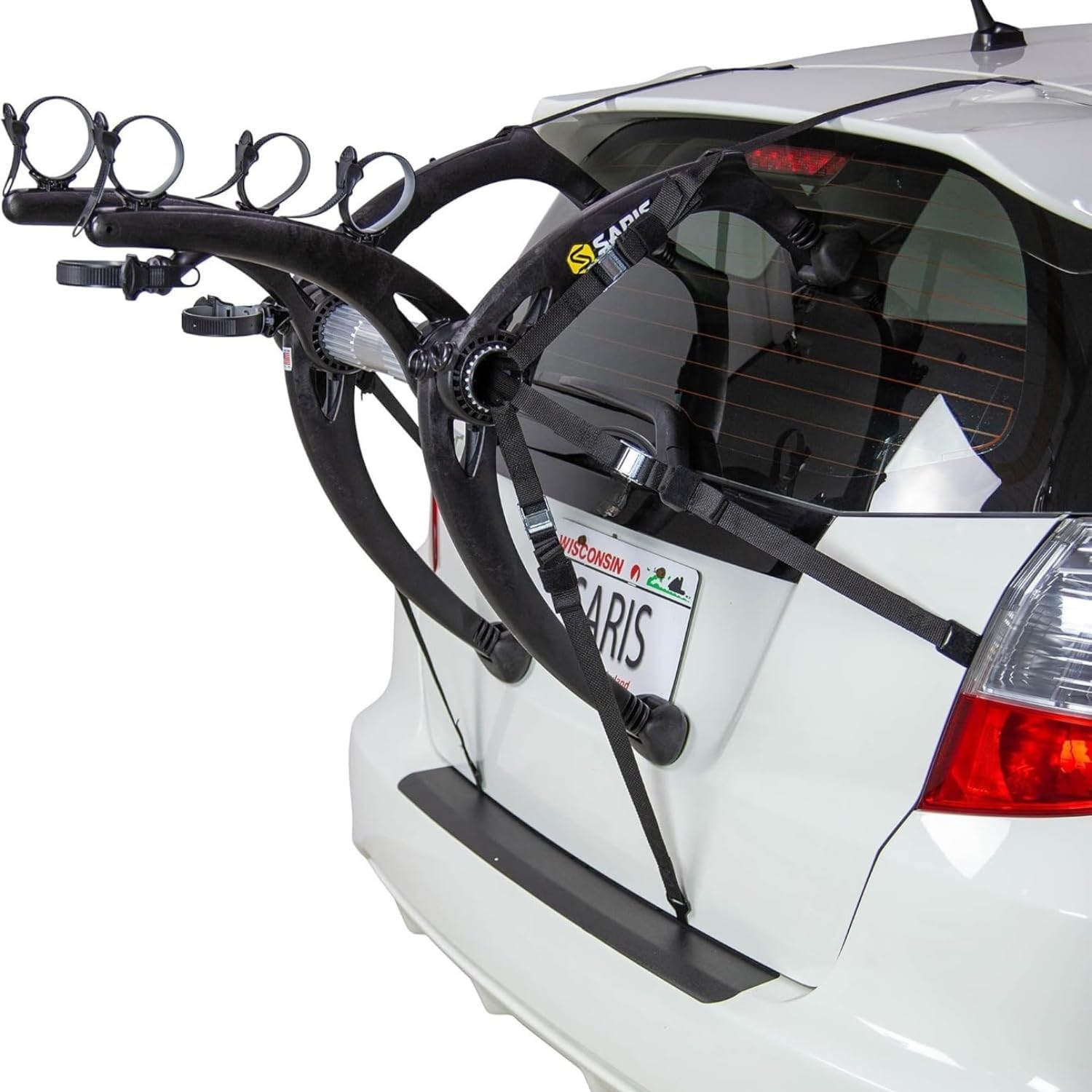
So, this is the Saris Bones EX which is well-known for trunk-mounted bike rack and it is light and easy to carry.
Even, you can install it with the straps and hooks and it is designed to reduce the contact points so it is less likely to rub paint when it properly fit and tightened in the correct way.
As well as, it comes with the injection-molded arms and legs that keeps the rack solid for years to come and there’s rubber feet that articulate to protect the paint as well.
How to Install Bike Rack for Jeep Wrangler – Perfect Guide
Properly installing a bike rack on a Jeep Wrangler is crucial for safety, stability, and longevity.
Because the Wrangler features a rear-mounted spare tire, higher ground clearance, and a swing-style tailgate, careful alignment and secure mounting help prevent rattling, swaying, or damage to the vehicle or the bikes.
Correct installation ensures the rack can withstand road vibrations, off-road bumps, wind pressure, and the combined weight of the bikes.
Whether installing a hitch rack, spare tire rack, or roof rack, the goal is to ensure the rack remains level, doesn’t obstruct the tailgate or taillights, and stays securely in place during travel.
1. Tools
Before installing a bike rack on a Jeep Wrangler, it’s essential to verify that the hitch receiver meets the rack’s requirements, specially if the rack is hitch-mounted.
Most Wrangler-compatible racks require a 2-inch hitch receiver as it supports better weight distribution and provides robust support for heavier bikes, such as e-bikes or fat-tire models.
Alignment is another crucial step, as the rack must be level and clear of the spare tire or rear bumper.
Some racks have built-in alignment guides, while others may require manual adjustment.
Torque recommendations are also important, as bolts and fasteners should be tightened to the torque levels specified by the manufacturer to prevent them from loosening during long drives or off-road use.
Proper preparation minimizes installation time and ensures a secure fit.
2. How to Install Different Kinds of Jeep Wrangler Bike Rack
1. Hitch Rack Installation
Installing a hitch rack on a Jeep Wrangler typically begins by sliding the rack’s mounting arm into the hitch receiver.
Once inserted, the rack should be aligned straight with the vehicle, ensuring it doesn’t tilt or sit unevenly.
Some racks utilize a locking hitch pin, while others use an anti-wobble system to tighten the connection.
After securing the rack, attaching the adjustment arms and straps ensures the bikes remain stable during travel.
Many modern hitch racks feature a tilt or swing mechanism, allowing access to the Wrangler’s tailgate without removing the rack.
Once installation is complete, the rack should feel sturdy and not wobble when shaken forcefully by hand.
2. Spare Tire Rack Installation
A spare tire rack attaches directly to the rear-mounted spare tire using a mounting plate or brackets that wrap around the tire structure.
The rack must be carefully centered, specially if the Wrangler has an offset spare tire or a larger aftermarket tire size.
After attaching the mounting brackets, tightening the main bolts or strap system secures the rack to the spare tire.
The arms and bike cradles are then adjusted to keep the bikes clear of the spare tire and rear window.
Some models have built-in clearance extensions to avoid interference with larger tire sizes.
When properly installed, the rack should remain firmly attached to the tire without tilting or wobbling when pressure is applied.
3. Roof Rack Installation
Installing a roof rack requires roof crossbars, which are typically only compatible with hard-top Wranglers.
After installing the crossbars according to the spacing requirements, the bike rack mounts onto the bars using clamps or bolt-on hardware.
The rack should be parallel to the roof and securely attached without any movement.
Because the Wrangler is tall, a small step stool or a helper may be needed to load bikes onto the roof rack.
After tightening all mounting points to the recommended torque levels, final adjustments ensure that the bike frame or wheels do not come into contact with the roof or windshield.
A secure fit prevents wind buffeting and improves driving stability.
3. How to Test It for Fit and Safety
After installation, it’s crucial to test the rack for proper fit and safety before loading bikes.
This includes checking that all bolts, straps, and fasteners are tightened to the recommended torque levels and confirming that the rack does not obstruct the brake lights, license plate visibility, or rearview camera.
The rack should not move or wobble when pushed firmly, and any moving joints should operate smoothly without binding.
A short road test helps verify stability, including listening for rattles or checking for movement while driving on rough or uneven terrain.
If anything moves, loosens, or rattles during the test, adjustments should be made before regular use.
Proper testing ensures the rack is ready for both highway trips and off-road trails with confidence and safety.
Read More:
How to Maintain Bike Rack for Jeep Wrangler & Some Safety Tips
Maintaining your bike rack and using it safely on your Jeep Wrangler is crucial, specially as this vehicle is often driven on rough terrain, steep trails, and long road trips.
Proper safety procedures help prevent damage to the bikes, the rack, and the vehicle, particularly when traveling on off-road surfaces where vibrations, dust, and sudden jolts can affect stability.
Regular maintenance also extends the life of the rack by protecting metal components from rust, corrosion, and wear.
Understanding how weight, visibility, and vibrations affect the rack helps ensure a safe and comfortable driving experience.
Now, it becomes really important to tight the fasteners to the specified torque values and also you should re-check those fasteners after the first short trip as an example after ~ 250 miles and yes you can check them at the regular time interval as well, you should always concentrate to the torque and re-check them as it literally improves trust and reduces the risk of the bike rack from loosening during the off-road vibrations.[¹]
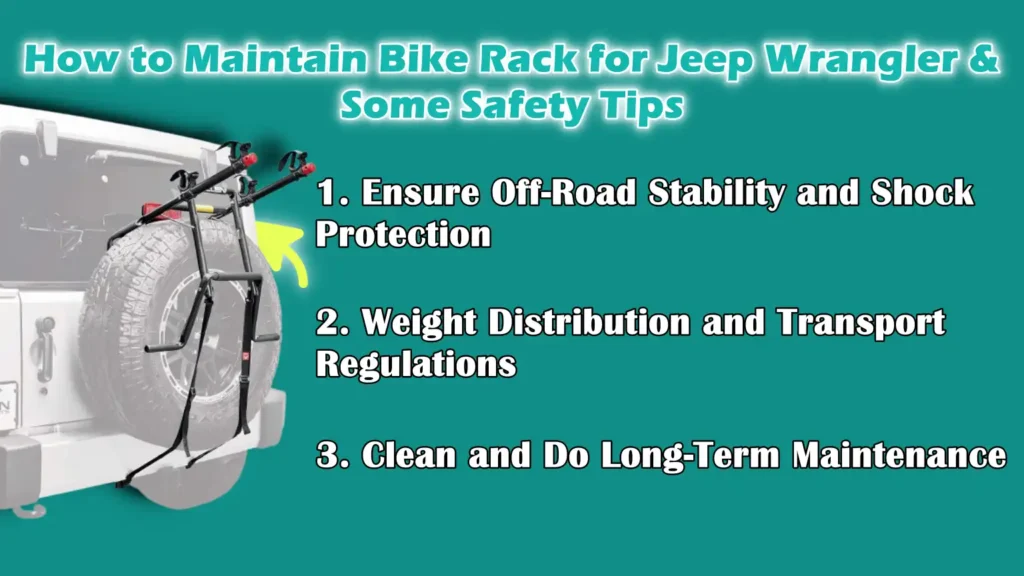
1. Ensure Off-Road Stability and Shock Protection
The Jeep Wrangler is built for off-road adventures, but rough terrain can cause significant vibrations and sudden movements that can impact a bike rack.
Using anti-sway bars, sturdy straps, or built-in stabilization systems helps prevent bikes from colliding with each other or shifting.
Vibration-resistant mounting systems are specially useful when driving on gravel, mud, or rocky surfaces, as constant movement can loosen bolts or straps if the rack isn’t properly stabilized.
Checking the rack before and after off-road driving ensures that no components have come loose.
Securing the bikes tightly prevents scratches on the frames, pedal contact, or wheel rotation during driving.
2. Weight Distribution and Transport Regulations
Weight distribution plays a critical role in safely transporting bikes on a Wrangler.
Heavier bikes, such as electric bikes or fat-tire models, should always be placed closest to the vehicle when using a multi-bike rack, as this reduces stress on the rack and minimizes movement during driving.
It’s also important to be aware of local transportation laws.
In many areas, the license plate and brake lights must remain visible even with a bike rack installed.
Some states require an auxiliary license plate mount or rear light bar if the rack or bikes obstruct them.
Understanding these requirements helps avoid fines and ensures safe road travel, specially at night or in inclement weather.
3. Clean and Do Long-Term Maintenance
Regular cleaning and maintenance help prevent rust and damage, specially as Jeep Wranglers are often driven in rain, mud, and dusty conditions.
Washing the rack with mild soap and water after off-road trips removes dirt that can weaken straps or damage moving parts.
Applying anti-rust spray or a protective coating helps steel racks last longer and prevents corrosion around bolts, hinges, and locking systems.
Checking the rubber straps and clamps is also crucial, as they can dry out or crack over time due to weather exposure.
Storing the rack indoors when not in use extends its lifespan and ensures it remains sturdy, secure, and ready for future adventures.
Conclusion – Best Bike Rack for Jeep Wrangler
It is true that whenever your equipment fits your vehicle in a perfect way, then you can actually feel that your trip is lot smoother, safer and far more enjoyable as well, which is why fitment is mandatory.
Because the Wrangler has a unique design, featuring a rear-mounted spare tire, high ground clearance, and off-road capabilities, not every bike rack will fit or perform well in all situations.
A properly matched rack protects bikes from damage, prevents movement during travel, and ensures that the tailgate and visibility remain unobstructed.
Understanding key factors such as weight capacity, secure mounting systems, weather resistance, and installation methods helps owners choose a rack that’s right for both their Wrangler model and their riding lifestyle.
Whether carrying lightweight road bikes, heavy electric bikes, or multiple mountain bikes, the right rack should feel stable and secure on highways, back roads, and off-road terrain.
With proper installation, regular checks, and basic maintenance, a high-quality bike rack can last for many years, making every outdoor trip easier, safer, and more enjoyable.
For many Jeep owners, the right rack becomes an essential part of their adventure setup, supporting freedom, exploration, and an active outdoor lifestyle.
So, that’s all from this one and if you still have confusion related to this guide, just let us know by commenting below this guide.
Frequently Asked Questions
Q1. Will any bike rack fit a Jeep Wrangler?
Answer: Not every bike rack will fit a Jeep Wrangler because this vehicle has a rear-mounted spare tire, a swing-open tailgate, and a rear design that differs from most SUVs. Many standard trunk racks or weaker racks won’t work because the spare tire blocks their mounting area. The best racks for the Wrangler are hitch-mounted racks and spare tire-mounted racks, as these designs are specifically made to accommodate the vehicle’s rear end and offer better spacing and stability. Some roof racks will also work if the Wrangler has factory crossbars or an aftermarket roof system. For proper fitment, always look for racks that are labeled Jeep Wrangler-compatible or spare-tire-compatible.
Q2. Can I open the tailgate after installing the rack?
Answer: Whether you can open the tailgate depends on the type of bike rack you choose. Most spare tire-mounted racks require removal or tilting before the rear door can be opened, specially when bikes are loaded. Many modern hitch racks feature a swing-away or tilt-down feature specifically designed for vehicles like the Wrangler. This feature allows access to the tailgate even with bikes loaded, making it easy to access gear, tools, or coolers in the cargo area. If accessing the tailgate is important to you, choosing a rack with a tilt or swing mechanism is best.
Q3. Can a Jeep Wrangler carry heavy bikes like electric bikes?
Answer: Yes, a Jeep Wrangler can carry heavy bikes like electric bikes, but you will need to choose a rack with a higher weight capacity. Electric bikes can weigh between 50 and 70 pounds, so a standard lightweight hanging rack may not be safe. A platform-style hitch rack is usually the best option because it supports the bikes evenly by their wheels and frames. Always check the total weight limit of both the hitch receiver and the rack to ensure the setup remains secure and stable during travel, specially off-road.
Q4. Do bike racks block license plates or rearview cameras?
Answer: Depending on the rack design and how many bikes are loaded, some racks may block the rear license plate, brake lights, or rearview camera. Some states require drivers to keep their license plates and lights visible at all times. If the rack blocks visibility, you may need an additional license plate holder or light extension. Some newer racks are designed to keep the backup camera clear or have adjustable mounting arms to avoid obstruction. It’s always important to check local regulations and visibility before driving.
Q5. Are bike racks safe for off-road driving on a Jeep Wrangler?
Answer: Bike racks can be used for off-road driving, but the rack must be robust, securely mounted, and rated for rough terrain. A good off-road-friendly rack should have anti-sway straps to prevent the bikes from moving or swaying, secure locking systems, and stable mounting points. Hitch-mounted racks are generally best for off-road use because they remain sturdy and are less likely to come loose. Spare tire racks can also work, but they should be checked frequently to ensure the bolts and straps remain tight. Before every off-road trip, it’s essential to manually test the rack by shaking it to ensure nothing is loose.
Q6. How many bikes can a Jeep Wrangler safely carry?
Answer: The number of bikes a Wrangler can carry depends on the maximum weight capacity of the rack and the strength of the hitch. Most racks designed for the Wrangler can safely carry two bikes. Some models can accommodate three or four bikes, but heavier loads require a robust hitch and rack. For off-road travel, two-bike setups are generally the safest as they minimize stress and movement. If you plan to frequently carry more than two bikes, look for a rack specifically designed for multiple bikes and pay close attention to the weight ratings.
Q7. How do I maintain my bike rack to make it last longer?
Answer: Maintaining a bike rack is easy and helps extend its lifespan. Regular cleaning is essential, specially after rain, mud, or off-road trips. Dirt and grime can damage straps or cause rust on metal parts. Using an anti-rust spray or a light lubricant keeps moving parts smooth and protected. Storing the rack indoors when not in use helps protect it from weather damage. Checking bolts, locks, and straps before each trip ensures safety and prevents loosening over time.
References:
[1] Quadratec® Spare Tire Mount Bike Rack, Installation Manual: Designed for Jeep ’76-’19 CJ, YJ, TJ, JK and JL Wrangler Vehicles
https://www.quadratec.com/sites/default/files/installation_instructions/KRI_HANGING_RACK_INST_A4_WEB.pdf

Jonathan, the passionate owner of Bicycle Time, brings a lifelong love for bikes and automotive craftsmanship, that reflects into every corner of the shop. With deep passion in both cycling and automotive accessories, Jonathan is more than just an expert.
